
Most people forget nearly everything they study within a few days.
You sit down, highlight textbooks, reread your notes, maybe even watch YouTube lectures, and by next week — it’s gone. It feels like you’re putting in the hours but getting nothing back.
Here’s the real problem: we were never taught how to study properly.
In this guide, we’ll break down how to remember what you study — using proven methods backed by cognitive science, productivity frameworks, and AI tools like NoteGPT.com to make the process 10x easier.
Whether you’re a student, professional, or lifelong learner — this system works.
Why You Forget What You Study (And What To Do About It)
Before we get into solutions, let’s cover the main reasons your brain dumps information after a study session.
1. Passive Learning Techniques
Most people use passive methods like:
- Rereading notes
- Highlighting textbooks
- Watching videos without engaging with the content
These strategies feel productive, but they don’t challenge your brain to recall or apply information.
2. Cognitive Overload
Trying to learn too much at once overwhelms your working memory. This means your brain can’t transfer knowledge into long-term memory.
3. No Review System
Without a system to revisit material, you’re subject to the Ebbinghaus Forgetting Curve — a psychological model showing that we forget 90% of what we learn within 7 days unless we review it.
The Science of Remembering: What Actually Works
Research shows that active recall, spaced repetition, and note compression are the most powerful strategies for long-term memory.
Let’s break these down.
Active Recall
Active recall is the process of pulling information out of your brain without looking at your notes. It’s far more effective than passively reviewing material.
Examples:
- Self-quizzing
- Teaching the concept to someone else
- Writing from memory
Spaced Repetition
Spaced repetition involves reviewing information at increasing intervals. This strengthens the neural pathways associated with that knowledge.
Review Schedule Example:
| Day | Action |
|---|---|
| Day 1 | Learn the material |
| Day 2 | First review |
| Day 4 | Second review |
| Day 7 | Third review |
| Day 15 | Final review |
Note Compression
Instead of taking pages of notes, summarizing complex material into simplified key points improves retention and reduces cognitive load.
Compressed Notes Look Like:
- Short summaries
- Bullet points
- Mind maps
- Diagrams
This is where AI note-taking tools like NoteGPT.com shine.
How NoteGPT.com Helps You Remember More in Less Time
Manual note-taking is time-consuming and often incomplete. AI-powered tools solve that.
What is NoteGPT.com?
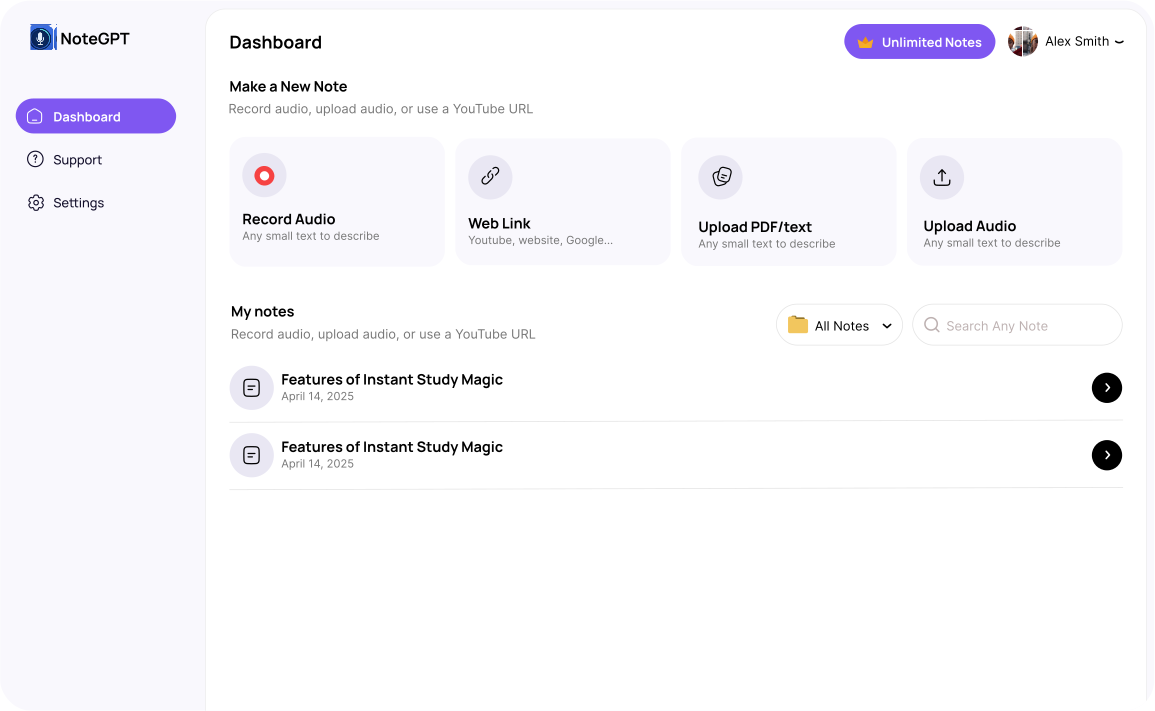
NoteGPT.com is an AI-powered note-taking and summarization app that automatically:
- Records meetings or lectures
- Converts audio into text
- Summarizes key points
- Suggests takeaways or action items
This makes it easier to compress and review content efficiently.
Key Features That Boost Memory
| Feature | Benefit |
|---|---|
| AI Summaries | Quickly turn long content into digestible notes |
| Smart Highlights | Identify and tag key ideas instantly |
| Custom Quizzes | Turn summaries into review questions |
| Spaced Review Tools | Get automatic reminders to review notes |
| Multimodal Input | Record, type, or upload content from any source |
How to Use NoteGPT for Memory Retention
- Upload or Record
Record a lecture, meeting, or training session directly in the app. - Summarize with One Click
Use NoteGPT’s AI to generate a clear and concise summary of the session. - Create Flashcards or Quizzes
Turn your summary into custom questions using GPT prompts or built-in quiz generation. - Set Up Review Reminders
Schedule spaced reviews to retain the material long term.
Proven Techniques to Remember What You Study (Step-by-Step)
Let’s combine best practices with NoteGPT’s tech to create a full memory system.
Step 1: Learn Actively From the Start
As you study:
- Ask yourself questions like “Why is this true?” or “What does this mean?”
- Explain the concept out loud in your own words
- Turn concepts into analogies
Step 2: Summarize with AI
Use NoteGPT to:
- Auto-generate key points from your source material
- Highlight relationships between ideas
- Create outlines that match your learning objectives
Step 3: Turn Notes into Questions
Instead of rereading summaries, ask:
- What is the definition of X?
- How does Y affect Z?
- Why is this concept important?
Use NoteGPT’s AI to help generate these questions instantly.
Step 4: Review with Spaced Repetition
Set reminders in your calendar or use a spaced repetition app. Combine this with your NoteGPT summaries and quiz yourself regularly.
Sample Schedule:
| Day | What to Review |
|---|---|
| Day 1 | Study session + AI summary |
| Day 2 | Quiz yourself on the summary |
| Day 4 | Review your quiz + retest |
| Day 7 | Review only difficult topics |
| Day 15 | Final test from memory |
Mistakes to Avoid When Trying to Remember What You Study
❌ Relying on Highlighting
Highlighting feels productive but doesn’t improve memory unless combined with recall.
❌ Rewriting Notes
Copying notes doesn’t engage the brain. Summarizing or teaching does.
❌ Last-Minute Cramming
Cramming might help for a test, but it kills long-term memory. Space out your learning.
❌ Ignoring AI Tools
Doing everything manually wastes time. Leverage apps like NoteGPT to streamline your learning system.
Real-World Examples & Use Cases
Let’s look at how different people use NoteGPT to study better.
Student Studying for Finals
- Records class lectures in NoteGPT
- Uses AI to summarize notes for each subject
- Generates quiz questions for key topics
- Sets spaced repetition alerts 3x per week
Result: Higher grades and less stress during exam week
Busy Professional Learning New Skills
- Uploads YouTube tutorials or webinars
- Gets a compressed summary using NoteGPT
- Uses key takeaways to build a weekly learning plan
Result: Learns faster without wasting hours
Team Leader in Corporate Training
- Uses NoteGPT to record meetings and training calls
- AI generates summaries and actionable takeaways
- Team reviews notes weekly instead of full meeting replays
Result: Improved retention, productivity, and fewer follow-up calls
Tools and Apps to Support Your Study Process
Here are some recommended tools (including NoteGPT) to help build a full system.
| Tool | Purpose | Price (USD) |
|---|---|---|
| NoteGPT.com | AI notes & summaries | Free trial, then from $9/month |
| Anki | Flashcard app for spaced repetition | Free |
| Notion | General note organization | Free and paid plans |
| Forest | Focus & productivity timer | $3.99 one-time |
| Obsidian | Knowledge base with backlinks | Free |
| Readwise | Highlight and sync summaries | From $4.49/month |
Summary: Build a Repeatable System
The key to remembering what you study isn’t about intelligence or talent — it’s about process.
Build a system with these parts:
- Learn Actively
Think critically, ask questions, and explain ideas as you study. - Summarize with AI
Use tools like NoteGPT.com to compress material into easy-to-review formats. - Review Using Spaced Repetition
Don’t cram. Space your reviews strategically. - Quiz Yourself
Turn your notes into questions. If you can’t answer them, you don’t know it yet. - Keep It Simple
Avoid huge walls of text. Work with outlines, key ideas, and summaries.
By combining cognitive science with smart AI tools, you don’t just study harder — you study smarter.
And you actually remember it.
Ready to try NoteGPT.com and remember more in less time?
Use AI to record, summarise, and review what matters most — all in one place.