
Organizing research notes can be frustrating. Whether you’re a student preparing for exams, a writer digging through background info, or a professional managing reports and documents, your notes often pile up — fast.
What starts as a few files quickly turns into a scattered mess of documents, screenshots, and sticky notes.
If you’ve been there, you’re not alone. The good news? With the right systems — and the help of AI — it’s easier than ever to turn disorganized notes into something useful.
In this guide, we’ll break down how to organize research notes effectively, using proven frameworks, AI tools, and practical methods that actually work.
Why Most People Struggle with Organizing Research Notes
Information overload is real
When you’re researching, it’s tempting to save everything — every link, every quote, every idea. But that leads to a bloated archive that’s hard to navigate. You end up with:
- Dozens of open tabs
- Multiple note apps or folders
- Inconsistent formatting
- Duplicate notes or incomplete thoughts
Lack of structure
A major problem is that most people don’t think about how they’ll use their notes later. Without a structure, your notes just become a dumping ground.
Common issues include:
- Saving notes under vague filenames (“Research1.docx”)
- Keeping everything in one giant file
- Forgetting where something is saved
- Having no system for retrieval
Manual systems don’t scale
Handwritten notes, random Word docs, and ad-hoc folders might work for small projects. But once you’re handling more than 10–15 sources, you need something scalable.
This is where a digital system — powered by AI — can make a huge difference.
Step 1: Choose the Right Note-Taking Method
Before organizing your notes, it helps to pick a consistent method. Some systems work better for deep research, while others are great for summarizing ideas quickly.
Common Note-Taking Frameworks
| Method | Best For | Description |
|---|---|---|
| Cornell Notes | Students, meeting notes | Divides page into cues, notes, summary. Great for retention. |
| Zettelkasten | Writers, researchers, creatives | Each note is a single idea. Notes link together to form a web of knowledge. |
| PARA | Business, productivity, entrepreneurs | Projects, Areas, Resources, Archives — keeps everything neatly categorized. |
| Mind Mapping | Visual thinkers | Creates visual diagrams of connected ideas. Helpful for brainstorming. |
Why consistency matters
No matter which method you choose, the most important thing is to stick to it. Switching between methods halfway through a project can create confusion and slow you down.
Step 2: Centralize Your Notes in One Place
Fragmentation kills productivity. If your notes are scattered across Google Docs, PDFs, physical notebooks, screenshots, and sticky notes, you’ll waste time just finding things.
Benefits of centralizing:
- Faster retrieval: No more digging through folders
- Improved organization: Everything follows the same format
- Easier to search and filter
- Better backups: One cloud-based location = less risk of losing data
Tools to centralize your research notes:
| Tool | Key Features | Price (USD) |
|---|---|---|
| NoteGPT | AI summaries, auto-tagging, file uploads, smart search | Free plan + Pro from $12/mo |
| Notion | Blocks, databases, integrations | Free + $10/mo for Pro |
| Obsidian | Markdown notes, local storage, plugins | Free + optional Catalyst support |
| Evernote | Web clipper, formatting tools, templates | Free + $14.99/mo Pro |
| OneNote | Deep Microsoft integration, flexible pages | Free with Microsoft account |
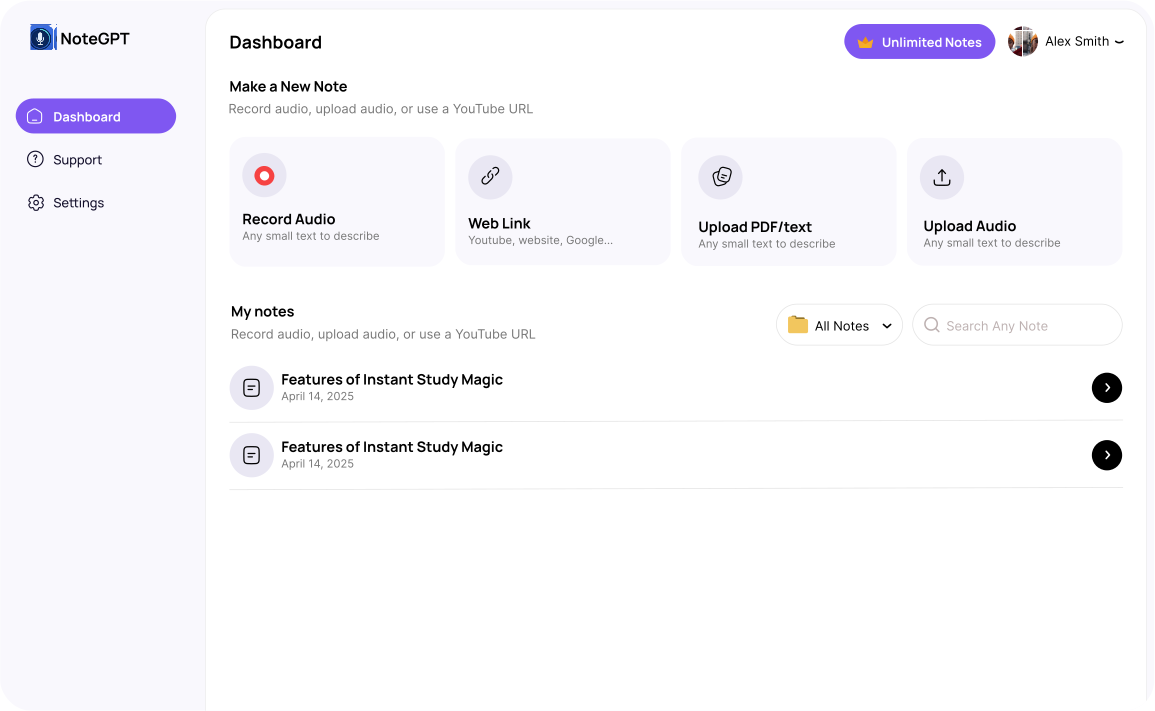
NoteGPT stands out here for researchers and professionals. It combines AI summarization, auto-tagging, and search — ideal when you’re handling large volumes of content or pulling from long documents and videos.
Step 3: Use Tags and Folders the Right Way
Organizing your research isn’t just about where you put your notes. It’s about how you can find them later.
Folders are great, but too many layers slow you down. Tags offer a more flexible, scalable way to group related ideas.
Folder vs Tag: What’s the difference?
| Feature | Folders | Tags |
|---|---|---|
| Structure | Hierarchical | Flat, non-hierarchical |
| Flexibility | Low — notes live in one folder | High — notes can have multiple tags |
| Use Case | General topics | Cross-topic themes or specific keywords |
| Example | “Marketing” folder | Tags: “email,” “copywriting,” “2023” |
Best practices:
- Keep folders broad (e.g. “Clients”, “Research”, “Content”)
- Use tags for specifics (e.g. “case study”, “finance”, “SEO”)
- Avoid creating too many folders. Use filters and smart search instead
- Standardize your tagging: singular vs plural, lowercase vs uppercase
NoteGPT’s AI auto-tagging uses natural language processing to suggest or apply tags automatically — saving hours of manual organization.
Step 4: Summarize and Highlight Key Ideas
This is where most research systems fall apart.
You gather a mountain of content, but never go back to it. Why? Because it’s too long, too dense, and takes too much time to review.
That’s why summarization is key.
Manual vs AI summarization:
| Method | Pros | Cons |
|---|---|---|
| Manual | Deep understanding, personalized | Time-consuming, subjective |
| AI (like NoteGPT) | Fast, consistent, works on large files | May miss nuance (but improving rapidly) |
What to summarize:
- Long-form articles
- PDFs or whitepapers
- Transcripts or meeting notes
- YouTube videos
- Podcast interviews
- Your own brainstorms or mind maps
With NoteGPT, you can upload any of these, and the app will:
- Pull out key points
- Auto-summarize
- Offer suggestions on what to tag or review
- Let you save and edit highlights
This saves hours and keeps your notes actionable.
Step 5: Link Notes Together
This is where your research becomes a living system — not just a static archive.
Linking ideas together helps you make connections, spot patterns, and build deeper insights.
Internal linking works best when:
- Notes are short and focused (one idea per note)
- Tags and summaries help group them
- You revisit notes over time
Benefits of linking:
- Builds your personal knowledge graph
- Encourages synthesis, not just storage
- Makes writing or presenting from your research 10x easier
If you’re familiar with Zettelkasten, this is the core idea. But with NoteGPT, you can get smart linking powered by AI — it identifies connections automatically, even across large research projects.
Step 6: Use AI to Keep Your Notes Updated and Relevant
One of the best features of an AI-powered note system like NoteGPT is that it doesn’t just store your notes — it works with them.
Features worth using:
- Smart reminders: Get alerts to review notes after a certain time
- Relevancy matching: AI brings up older notes when they match your current topic
- Search assistant: Ask questions and let the app surface relevant notes
Instead of your notes collecting digital dust, they stay active and useful. AI tools ensure that your research system keeps growing, learning, and adapting with you.
Step 7: Make Your Notes Work for You
Once your research notes are well-organized, the next step is to actually use them.
This is where most people stop short. They collect notes for a paper, a campaign, a report — and never reuse them.
Use cases for organized notes:
- Writing articles, essays, or content
- Planning projects or strategies
- Preparing for presentations or meetings
- Training new team members
- Creating SOPs or documentation
Well-organized research lets you repurpose ideas fast — across multiple projects.
With NoteGPT’s AI summaries and smart search, you can turn raw research into polished insights in minutes, not hours.
Quick Checklist: How to Organize Research Notes with NoteGPT
| Step | Action | Feature to Use in NoteGPT |
|---|---|---|
| 1 | Pick a note-taking method | Basic templates, Markdown support |
| 2 | Centralize your research in one place | File uploads, cloud sync |
| 3 | Use tags and folders consistently | Auto-tagging, filters |
| 4 | Summarize key ideas | AI summarization |
| 5 | Link related notes | Smart linking, internal backlinks |
| 6 | Keep notes fresh and useful | AI reminders, search assistant |
| 7 | Apply notes in real-world use | Export, edit, share features |
Final Thoughts
Research is only valuable if you can use it. Organizing your notes isn’t about being neat for the sake of it — it’s about being able to turn raw information into smart decisions.
With tools like NoteGPT.com, the heavy lifting is taken care of:
- You can summarize huge documents
- Keep everything tagged and searchable
- Make connections between ideas automatically
- Actually reuse what you’ve researched
Whether you’re writing a thesis, building a business, or just trying to stay on top of your ideas — organizing your research notes with AI is a game-changer.