
Most meetings waste time, drain focus, and don’t lead to clear outcomes. They’re often too long, include too many people, and lack any real structure.
This guide breaks down exactly how to fix that — with simple, research-backed strategies to help you run shorter, more effective meetings that lead to real decisions and action.
TL;DR: Effective Meeting Strategies
Most meetings waste time because they lack purpose, include too many people, and fail to produce clear outcomes. Research from Microsoft, Stanford, and CIPD shows that better meetings come from fewer attendees, question-based agendas, and clear decision-making structures. This article gives you a proven system to fix that, including:
- A 6-line meeting template to define outcomes before the meeting starts
- Simple rules for who should (and shouldn’t) be in the room
- How to write agendas as questions and use timeboxing to stay focused
- Smart facilitation roles and tactics that improve participation and clarity
- How to reduce Zoom fatigue with remote-friendly strategies
- A lightweight scorecard to track and improve meeting quality over time
Use these strategies to stop wasting hours in meetings that go nowhere — and start running sessions that actually move work forward.
The Real Cost of Ineffective Meetings
Research shows that the cost of bad meetings isn’t just about time — it’s about energy, clarity, and morale. When employees are pulled into meetings that lack direction, they’re not only disengaged but also mentally drained, which negatively impacts their focus and performance for the rest of the day.
- Microsoft’s study on digital work patterns found that users of Microsoft 365 are interrupted, on average, every two minutes by notifications, emails, or meetings.
- Another Work Trend Index report confirmed that inefficient meetings are the top workplace productivity disruptor.
- A global study covering 41 countries revealed that fewer than half of employees find their meetings to be a productive use of time.
These statistics highlight a structural issue in how meetings are currently planned and executed. Too often, meetings are scheduled by default, lack any meaningful agenda, include too many people, and fail to produce a clear outcome.
In an environment where every hour of team time matters, that kind of inefficiency becomes expensive — both in dollars and opportunity cost.
Should This Even Be a Meeting?
One of the simplest yet most powerful strategies for improving meeting culture is asking a single question before scheduling: “Does this really need to be a meeting?” You’d be surprised how often the answer is no.
Here’s a simple decision tree to help guide that choice:
| Scenario | Best Format |
|---|---|
| Status update or report | Async update (Slack, Notion, email) |
| Brainstorming or decision-making | Synchronous meeting (video/in-person) |
| One-on-one feedback | Private call or DM (optional meeting) |
| Information sharing | Loom video, memo, async post |
| Emergency or crisis | Immediate call or meeting |
Key signs a meeting is unnecessary:
- The topic doesn’t require live discussion or collaboration.
- There’s no defined decision to be made.
- The meeting is recurring “just because” with no recent value.
- No one has time to prepare or bring relevant updates.
By challenging whether a meeting is needed in the first place, teams can cut down on recurring sessions and redirect that time toward real work. This mindset alone can recover several hours each week per person.
The 6-Line Meeting Spec (Template)
If you decide the meeting is necessary, the next step is to define it clearly. That starts with a 6-line meeting spec — a compact yet powerful way to design meetings that deliver.
Copy-paste template:
- Outcome: By the end, we will have ______.
- Type: Decision / Plan / Alignment / Problem-solve / Learning
- Decider: ______
- Pre-read (5 mins max): link + what to comment on
- Agenda questions (max 3): ______
- Timeboxes: ______
This simple structure solves three common problems in one go: it forces clarity on what success looks like, it reduces vague or wandering conversations, and it gives participants a reason to care.
When every meeting has a purpose — like choosing between options or solving a real problem — people are more focused and invested. Meetings should be treated like mini-projects with deliverables, not calendar fillers. And if someone doesn’t complete the pre-read? That’s a signal the meeting should be canceled or moved to async until the team is ready.
Designing Better Agendas: Questions, Not Topics
A generic meeting agenda like “Marketing update” or “Q1 Planning” leaves too much room for vague conversation. Instead, frame agenda items as questions that need answers. This makes it much easier to focus the discussion and avoid rambling.
Why questions are more powerful:
- They clarify the problem being solved.
- They guide people to prepare relevant input.
- They make it obvious when a topic has been resolved.
Examples of strong agenda questions:
- “What are the 2 options we’re choosing between — and what’s the recommendation?”
- “What would make this plan fail, and how do we de-risk it?”
- “What is the smallest next step we can ship this week?”
Alongside question-based agendas, use timeboxes for each item. Not every topic deserves equal airtime. Allocate 5, 10, or 15 minutes per item to stay on track and protect people’s time.
Keep the Guest List Short
One of the easiest ways to make meetings more effective is to simply invite fewer people. Just because someone is tangentially related to a project doesn’t mean they should sit in every meeting about it.
Invite only:
- The decider (or someone with decision authority)
- Contributors with critical context
- Owners of follow-up actions
- Stakeholders only if live input is required
Research from PMC shows that meetings with too many participants lead to disengagement and lower effectiveness. People tend to “hide in the crowd,” and valuable discussion turns into passive listening.
A smaller group not only saves time but also leads to faster decisions. For large teams, consider holding a small working session first and sharing the outcome via async update.
Facilitation Tactics That Keep Meetings Productive
A great facilitator can be the difference between a chaotic meeting and a focused, high-impact one. Whether it’s a manager, team lead, or rotating team member, someone should own the flow of the meeting.
Common facilitation roles:
- Facilitator: Ensures the conversation flows and sticks to the agenda.
- Timekeeper: Watches the clock and flags when timeboxes are ending.
- Note-capturer: Logs key decisions and action items.
- Decider: Makes or confirms final calls on directional questions.
Proven tactics that work:
- Silent start (2–3 minutes): Everyone writes down their ideas or risks first. This helps reduce bias from dominant voices.
- Round-robin responses: Ensures everyone speaks, even briefly.
- Parking lot: Set aside off-topic but important issues for later.
- Decision close: Summarize what’s decided, check for objections, and assign owners.
These techniques are all backed by evidence from sources like CIPD and arXiv, which show that meetings with clearly defined roles and inclusive participation have measurably better outcomes.
Don’t Skip the Human Moment
It might feel counterintuitive, but adding a short personal check-in at the start of a meeting can improve engagement and build psychological safety. According to CIPD, even 90 seconds of small talk makes a difference in trust and collaboration.
Try questions like:
- “One word check-in: How’s your energy today?”
- “What’s one thing you need from this meeting to make it worth your time?”
These small rituals create space for connection, especially in remote or hybrid environments where it’s easy to feel detached. Done consistently, they boost team cohesion without adding significant overhead.
How to Capture Decisions That Actually Stick
The best meetings end with clarity — not just on what was discussed, but on what’s happening next. Summarize decisions with a short written format that can be sent within 24 hours.
Post-meeting summary template:
- Decision: What did we agree to do?
- Why: What was the rationale?
- Owner: Who’s responsible?
- Due date: When is it expected?
- Risks: What could block this?
- Next checkpoint: When will we review?
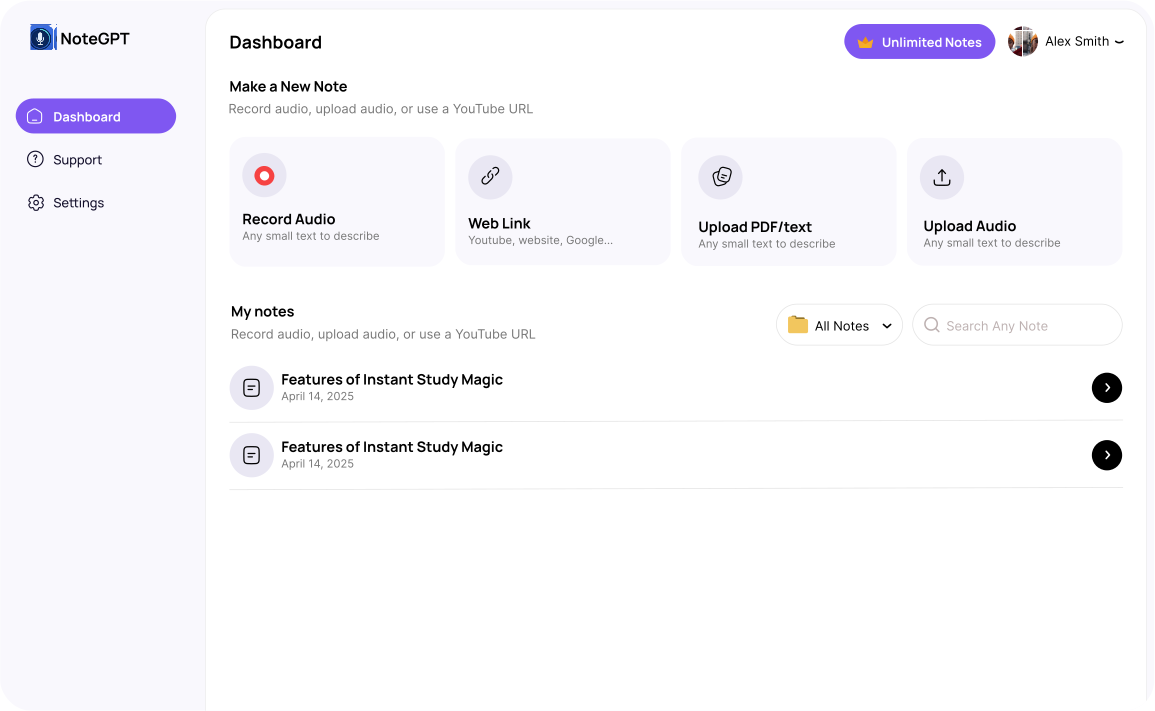
Sending this to attendees helps maintain alignment and avoid confusion later. It also holds people accountable. Templates like this are simple to automate using note-taking tools like NoteGPT.com, which can automatically capture action items and structure decisions clearly.
Remote and Hybrid Meeting Strategies
Remote meetings come with their own set of challenges. People often feel more drained after video calls due to reduced movement, self-monitoring from looking at their own face, and trying to interpret non-verbal cues through a screen. This is known as Zoom fatigue — and it’s real.
According to Stanford’s Virtual Human Interaction Lab:
- Video fatigue increases with longer meetings and no breaks.
- Turning off self-view and allowing camera-optional segments helps.
- Women tend to experience stronger Zoom fatigue than men, particularly when required to appear on screen all day.
Practical tips for remote meetings:
- Set meetings to 25 or 50 minutes to allow natural breaks.
- Make cameras optional for non-interactive portions.
- Encourage turning off self-view in Zoom or Teams.
- Use async tools for updates that don’t require discussion.
- Keep groups small to reduce overload and encourage contribution.
Adapting meeting formats to reduce fatigue can improve engagement, especially for remote teams working across time zones or dealing with frequent calls.
Scorecard: How to Measure Meeting Quality
Improving meetings isn’t a one-time fix — it’s an ongoing process. A simple scorecard can help track how meetings are working (or not) without turning into bureaucracy.
Per-meeting survey (takes 10 seconds):
| Question | Format |
|---|---|
| Was the outcome achieved? | Yes / No |
| Clarity of next steps? | 1–5 scale |
| Inclusion: Did everyone contribute? | 1–5 scale |
Monthly team metrics to monitor:
- % of meetings with agenda + outcome defined
- Median number of attendees per meeting
- % of action items completed on time
- Hours spent in recurring meetings (cut lowest-value 20%)
By tracking these signals, teams can gradually improve their meeting hygiene and free up more time for focused work.
Final Thoughts
Meetings don’t have to be productivity killers. With clear intent, better facilitation, and simple tools like templates and scorecards, you can run meetings that actually move work forward — instead of just talking about it. The key isn’t adding more structure or formality, but making every meeting earn its spot on the calendar.
For teams using tools like NoteGPT.com, these strategies become even easier to implement. Automated note-taking, action tracking, and meeting summaries help reduce the mental load and increase follow-through. When paired with the strategies outlined here, NoteGPT can become a central part of a meeting system that works.