
Taking notes in class has always been a pillar of academic success. Whether you’re in high school, college, or professional development programs, the way you capture and organize information can significantly influence how well you retain and apply it.
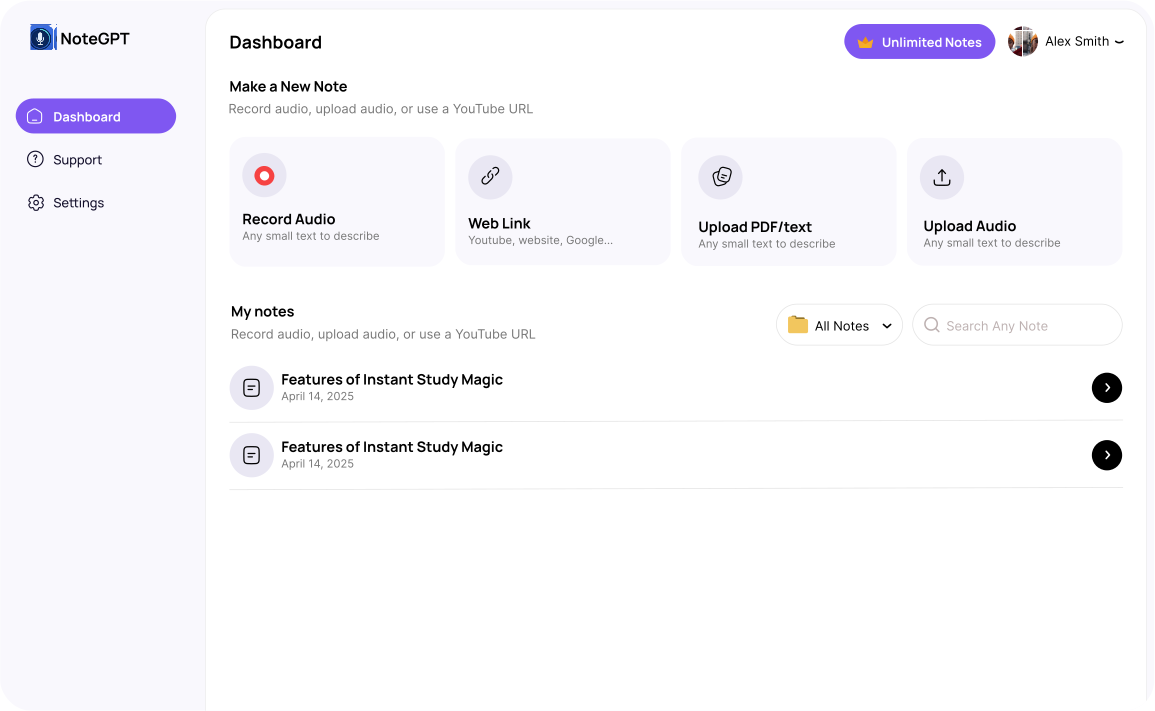
But note-taking has evolved. With AI-powered tools like Notgept.com, students now have a smarter, faster, and more organized way to keep up with lectures, discussions, and complex topics.
This guide explores how to take effective notes in class—using both traditional techniques and the powerful assistance of an AI note-taker.
Why Good Note-Taking Still Matters in the Age of AI
AI can help, but it doesn’t replace critical thinking. Note-taking serves several cognitive functions that directly impact learning:
Cognitive Benefits of Note-Taking
- Active listening: Taking notes forces your brain to focus on key ideas rather than passive absorption.
- Encoding memory: Writing things down—whether manually or digitally—improves retention.
- Clarifying understanding: When you rephrase what you hear, you’re engaging deeply with the material.
- Creating study material: Your notes become the foundation for later reviews, quizzes, and exams.
Even when using AI tools, the goal isn’t to outsource thinking—it’s to enhance it.
Common Challenges Students Face in Taking Notes
Before diving into the how-to, let’s acknowledge why note-taking feels hard for many students.
| Challenge | Why It Matters |
|---|---|
| Writing too slowly | You miss important details trying to keep up |
| Disorganized notes | Difficult to review later or use for studying |
| Not knowing what to write | Leads to over-noting or under-noting |
| Passive listening | You rely on slides or recordings instead of engaging |
| Multitasking or distraction | Reduces comprehension and retention |
An AI tool like Notgept addresses many of these by automatically capturing and organizing the lecture—but understanding the fundamentals of note-taking still gives you the edge.
Traditional Note-Taking Methods (And When to Use Them)
You don’t need to abandon old-school methods—especially when AI can complement them. Here are three of the most effective frameworks:
1. Cornell Method
Structure:
- Left column: Key terms and questions
- Right column: Notes from the lecture
- Bottom section: Summary in your own words
Ideal for:
- Humanities, history, or social science classes with lots of theory and discussion.
Why it works:
- It encourages active engagement and post-class review.
2. Outline Method
Structure:
- Use indentation to show hierarchy of ideas
- Main topics → Subtopics → Examples or facts
Ideal for:
- Fast-paced lectures or content-heavy topics
Why it works:
- Helps show relationships between concepts, making it easier to study later.
3. Mapping / Mind Map Method
Structure:
- Central idea in the middle
- Branches for major points
- Sub-branches for supporting facts or examples
Ideal for:
- Visual learners, brainstorming sessions, or interdisciplinary subjects
Why it works:
- Promotes non-linear thinking and helps with memory recall.
How AI Note-Takers Like Notgept.com Change the Game
AI tools bring efficiency and scalability to note-taking. Platforms like Notgept.com do more than just record—they listen, transcribe, summarize, and help you stay organized automatically.
Key Benefits of Using AI for Notes
- Real-time transcription: Get accurate text as the speaker talks.
- Speaker recognition: Identify who said what in group discussions.
- Automatic summarization: Break long content into digestible summaries.
- Searchable archives: Instantly find past topics or keywords.
- Collaboration features: Share notes with classmates or instructors.
With Notgept, you can stop worrying about writing everything down and start listening actively. The tool will keep track of the essentials while you focus on understanding.
How to Use Notgept Effectively in Class
AI tools are only as useful as the way you use them. Here’s how to maximize Notgept in different classroom settings.
Before Class
- Create a dedicated session in the app.
- Label your recording with date and topic.
- Review last class’s summary so you know where today picks up.
During Class
- Enable real-time transcription to follow along as you listen.
- Use manual highlights or tags if you hear something important.
- Avoid multitasking—Notgept handles the writing, so stay focused.
After Class
- Use the summary tool to generate key takeaways.
- Edit and annotate if the AI missed something nuanced.
- Turn bullet points into questions for self-quizzing or flashcards.
Best Practices
- Sync with your calendar or LMS (if supported).
- Download notes as PDF or markdown for backup.
- Share with classmates or tutors to compare notes.
Manual vs. AI Note-Taking: Pros and Cons
| Feature | Manual Note-Taking | AI Note-Taking (Notgept) |
|---|---|---|
| Speed | Slower | Real-time |
| Accuracy | Prone to human error | 95–98% transcription accuracy |
| Comprehension | Higher (you process info as you write) | Medium (unless you review later) |
| Organization | Depends on user | Automated tagging & folders |
| Review Efficiency | Moderate | High (searchable + summarised) |
| Cost | Free (paper/pen) | Typically $10–30/month for premium plans |
Tip: Combine both. Use AI to capture everything, then skim and write your own summaries or flashcards after class.
Features That Set Notgept Apart
If you’re already using Notgept or considering it, here’s what makes it stand out among AI note-takers.
Key Features Breakdown
| Feature | Description |
|---|---|
| AI Summary Engine | Automatically condenses lectures into bullet points |
| Topic Detection | Organizes notes by subject and keyword |
| Speaker Separation | Labels who said what in multi-person conversations |
| Audio + Text Sync | Click any sentence to hear it replayed |
| Note Collaboration | Share, comment, or co-edit with classmates |
| Cloud Storage | Keep notes accessible on any device |
| Language Support | Works with English, Spanish, French, and more |
| Pricing | Starts at $0, with Pro at $19/month |
Tips for Students Using AI Note-Takers
Even with Notgept doing the heavy lifting, there’s still value in intentional studying. Here’s how to get the most from your notes:
Convert AI Notes Into Study Material
- Pull 5–10 key questions from each session.
- Create a weekly summary slide deck.
- Record yourself reciting notes aloud.
- Use AI summaries as flashcards with Anki or Quizlet.
Combine AI With Active Recall
- After reviewing notes, close your device and try to recall what you just read.
- Write your own version of the summary.
- Teach the topic to a friend or family member.
Use Tags and Labels Smartly
- Tag notes with topics (e.g., “biology,” “calculus”) for easy search.
- Label action items for quick task management.
- Use emojis or colour codes to visually prioritise.
Case Studies: Real Students Using Notgept
Case Study 1: Maria, Pre-Med Student
- Problem: Couldn’t keep up with dense biology lectures.
- Solution: Used Notgept for live transcriptions.
- Result: Increased quiz scores by 15% in 3 weeks.
Case Study 2: James, Community College Student
- Problem: Struggled with ADHD and note organization.
- Solution: Let Notgept handle notes, reviewed summaries after class.
- Result: Saved 6+ hours/week and reduced overwhelm.
Case Study 3: Lisa, ESL University Student
- Problem: Missed key terms during lectures.
- Solution: Used Notgept’s audio sync + summaries to review in native language.
- Result: Improved comprehension and language skills.
Pricing Comparison: Notgept vs. Competitors
| Platform | Free Tier | Paid Tier (USD/month) | Key Features |
|---|---|---|---|
| Notgept | Yes | $19 | AI summaries, speaker ID, audio sync |
| Otter.ai | Yes | $16.99 | Live transcription, limited summaries |
| Sonix.ai | No | $22 | High-accuracy transcription |
| Notion AI | Yes | $10–15 | Notes + workspace features |
Notgept balances powerful AI tools with a simple, intuitive interface—ideal for students of all levels.
FAQs: How to Take Notes in Class with AI
Yes—manual notes reinforce memory. Let AI handle the capture, and use your own summaries for studying.
Absolutely. It can separate speakers and share collaborative notes easily.
Some features require internet, but offline recordings can sync once you’re back online.
Accuracy depends on audio quality, but most users report 95–98% accuracy.
It’s available on iOS, Android, and web browsers.
Final Thoughts: The Future of Learning Is Assisted, Not Automated
Note-taking isn’t about just collecting information—it’s about understanding it. While tools like Notgept make capturing classroom content easier than ever, you are still the one doing the learning.
AI should save you time, reduce friction, and give you more mental bandwidth. Use that energy to focus on what really matters: understanding concepts, connecting ideas, and preparing for exams.
If you’re not already using an AI note-taker, now is the time. It’s not about doing less—it’s about learning smarter.