
Visual learners process information best through images, diagrams, charts, and spatial layouts.
If you tend to remember what you see rather than what you hear or read, you’re likely in the majority—research suggests that 65% of people fall into the visual learner category.
Traditional note-taking apps are designed for text. But that’s not how visual learners think. They remember shapes, colors, and structure—not plain paragraphs.
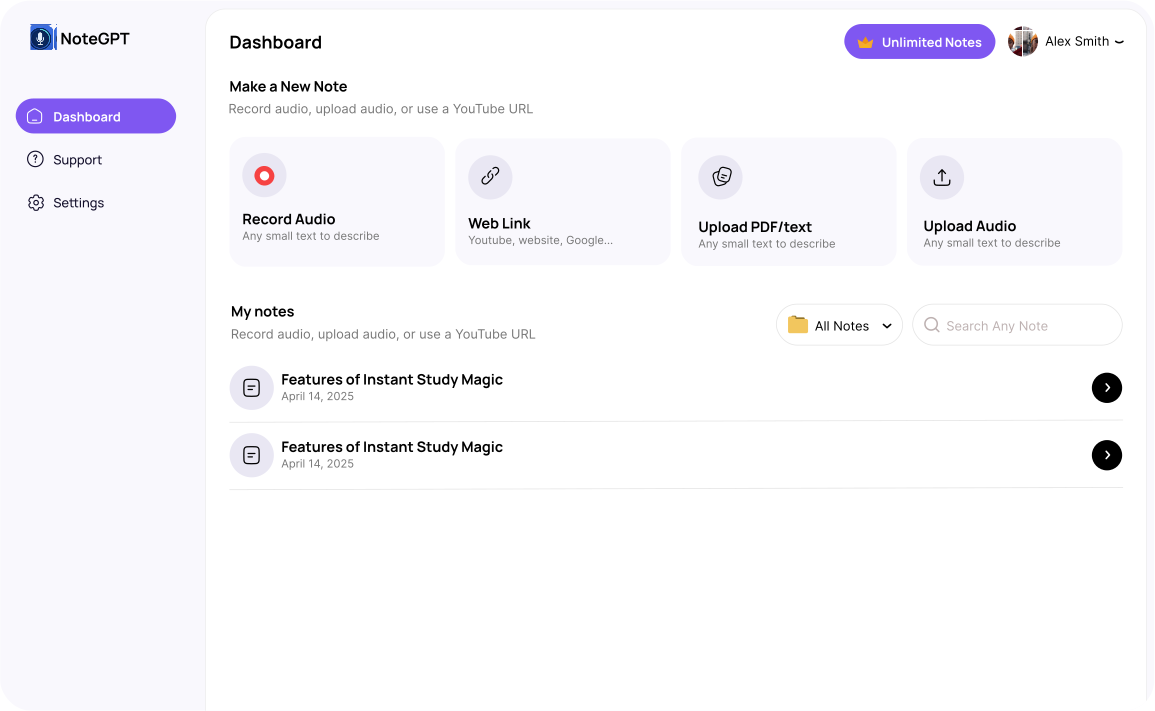
That’s where NoteGPT.com steps in. It’s not just a basic AI summarizer. It’s a note-taking assistant that can actually make your study process faster, more visual, and much easier to remember.
Let’s break down how visual learners can use AI tools like NoteGPT to improve study efficiency—and walk through practical study strategies that are built for the way your brain works.
What is a Visual Learner?
Before diving into study methods, it’s important to understand how visual learners absorb and recall information.
Key Traits of Visual Learners:
- Learn best by seeing
- Prefer charts, diagrams, maps, and mind maps
- Tend to highlight and color-code notes
- Often struggle with audio-only instructions
- Like neat, organized layouts with visual structure
Visual learners aren’t just “people who like colors.” Their brains literally process and retain visual cues faster and more efficiently than audio or text-based learners. So, forcing them into traditional lecture-style or text-heavy learning formats is setting them up for failure.
With that in mind, let’s look at the best study methods tailored specifically for visual learners—and how tools like NoteGPT.com make these methods 10x easier to use.
1. Use Mind Maps to Connect Ideas Visually
One of the most effective study methods for visual learners is mind mapping. It’s a technique that allows you to lay out concepts in a branching structure. Instead of reading bullet points in a list, you’re seeing how ideas connect across topics.
How Mind Maps Work:
| Concept | Description |
|---|---|
| Central Idea | The main topic goes in the center |
| Branches | Key subtopics extend from the center |
| Leaves | Supporting facts or ideas go on smaller branches |
| Visuals | Use icons, color-coding, or shapes to group ideas |
Why Visual Learners Love This:
- They can see the whole structure of a topic on one page
- It helps reinforce connections between different concepts
- It taps into their spatial memory, improving long-term recall
How NoteGPT Helps:
- Automatically summarizes text into mind map format
- Turns lecture notes into visual trees with expandable branches
- Saves time by generating maps in under 30 seconds
Pro Tip: You can export your mind maps and review them before exams. Even just glancing at them helps with memory recall.
2. Highlight and Color-Code Your Notes
Color is one of the most powerful memory aids for visual learners. Instead of re-reading notes multiple times, visual learners can categorize and remember information based on color.
Common Color-Coding Strategies:
- Blue: Definitions and keywords
- Green: Important dates or facts
- Red: Critical concepts or warnings
- Yellow: Questions or review points
How to Structure Your Notes with Color:
| Type of Info | Suggested Color |
|---|---|
| Terms & Definitions | Blue |
| Dates or Stats | Green |
| Main Ideas | Red |
| To-Review Later | Yellow |
How NoteGPT Helps:
- Auto-highlights important text using AI tagging
- Lets users choose custom colors for different data types
- Maintains consistent formatting across all your notes
If you’re reading a textbook or watching a lecture, you can copy the text into NoteGPT, and it will generate a highlighted, color-coded summary automatically. No manual effort needed.
3. Convert Notes into Slide Decks and Infographics
Text-heavy summaries can become overwhelming for visual learners. Instead, try studying from slide decks or infographics. These formats use short text, visuals, and layout spacing to make information easier to digest.
Slide Deck Benefits:
- Breaks content into bite-sized chunks
- Forces clarity and simplicity
- Adds visual structure and spacing
Infographic Benefits:
- Combines icons, visuals, and text
- Organizes complex ideas into a single image
- Boosts recall during last-minute reviews
How NoteGPT Helps:
- Converts your AI summaries into PowerPoint-style slides
- Creates infographic-style summaries of your topics
- Customizes layout and visuals based on subject
Real-Life Use Case: If you’re studying for a biology exam, NoteGPT can convert your textbook chapter into a slide deck with diagrams of cells, key terms, and visual flashcards—all generated in a few clicks.
4. Add Diagrams and Visual Cues
Diagrams help visual learners break down complex systems into visual parts. Whether you’re dealing with life cycles, processes, or cause-effect chains, diagrams make it easier to understand and retain.
Examples of Helpful Diagrams:
- Flowcharts for processes (e.g. “how a bill becomes law”)
- Venn diagrams for comparisons
- Timelines for historical events
- Labeled graphics for anatomy or geography
How NoteGPT Helps:
- Uses AI to generate diagrams from summaries
- Allows uploading of visuals and tags them with context
- Auto-detects key points and creates a corresponding visual
By pairing diagrams with text summaries, you can double your retention and speed up exam prep.
5. Use Spatial Layouts and Templates for Structure
Visual learners often rely on where something is on a page. That’s called spatial memory. When notes are randomly formatted or unstructured, it becomes harder to remember where certain facts are located.
How to Use Spatial Layouts:
- Use consistent templates for different subjects
- Align headings, notes, and visuals in the same position each time
- Group related items visually (boxes, columns, icons)
How NoteGPT Helps:
- Offers consistent note layouts with templates
- Remembers your style preferences
- Auto-tags sections and keeps them in fixed order
It’s not just about what’s in your notes—it’s about how your brain remembers the layout. Consistency improves retention dramatically.
6. Flashcards with Visuals
Flashcards are a proven tool for active recall. But visual learners benefit most when flashcards include images, icons, and colors.
Visual Flashcard Examples:
| Term | Image | Color |
|---|---|---|
| Photosynthesis | 🌱 | Green |
| U.S. Constitution | 📜 | Blue |
| Supply & Demand | 📉📈 | Red |
How NoteGPT Helps:
- Generates flashcards automatically from your notes
- Adds visuals using icons and emojis
- Supports spaced repetition for long-term memory
You can even create decks by topic and share them with classmates or export them for review on mobile.
7. Spaced Repetition with Visual Cues
Spaced repetition is a technique that improves memory by showing you key information at increasing intervals. Combine this with visuals, and the results are powerful.
Why This Works for Visual Learners:
- Repeated exposure helps build long-term memory
- Visual context enhances recognition
- Reduces time spent re-reading everything
How NoteGPT Helps:
- Reminds you to review past notes based on importance
- Uses visual markers to signal how long it’s been since you last reviewed
- Supports tagging for auto-resurfacing critical notes
Bonus: Study Tips for Using NoteGPT.com Effectively
Here’s how to get the most from NoteGPT.com as a visual learner:
Do:
- Break long content into chunks for visual summaries
- Use AI to auto-highlight and organize key terms
- Export notes to PDF and print mind maps for offline study
Don’t:
- Rely only on plain text AI summaries
- Ignore template consistency—it helps your brain organize info
- Forget to review spaced content regularly
Pricing + Accessibility
NoteGPT offers a freemium model with the ability to upgrade.
Example Pricing (as of Oct 2025):
| Plan | Features | Price |
|---|---|---|
| Free | Basic AI summaries, limited highlights | $0/month |
| Pro | Unlimited summaries, visual notes, mind maps | $12/month |
| Team | Collaboration, export options, template sharing | $29/month |
With tools like these, you can save hours of study time, and more importantly, actually remember what you learned.
Final Thoughts
Visual learners need more than words—they need structure, clarity, and design. With NoteGPT.com, visual learners finally have a study tool that works the way they think.
By combining:
- Mind maps
- Diagrams
- Highlighted notes
- Slide decks
- Flashcards
You’re not just taking notes—you’re building a visual study system backed by AI.
If you’re tired of forgetting what you studied, or wasting hours re-reading messy notes, give NoteGPT a try. It’s built to make your brain’s natural learning style work for you—not against you.