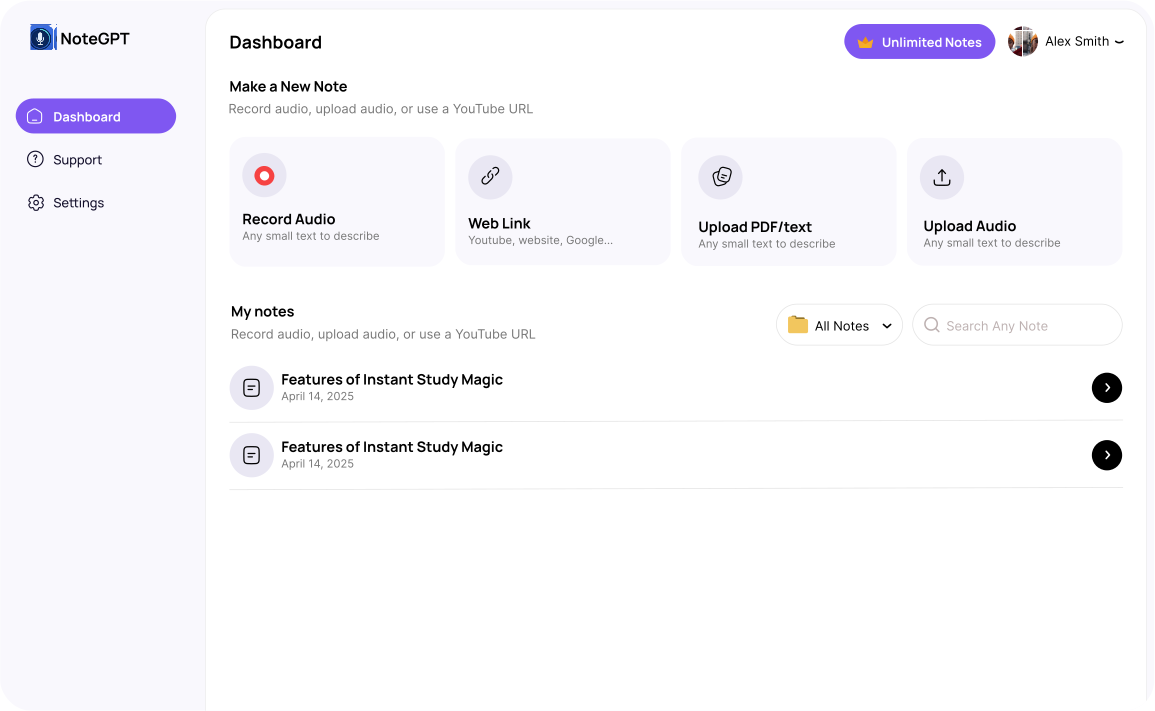

AI note takers can transcribe a 90-minute lecture in seconds and hand you a tidy bullet-point summary.
Handwritten notes take real effort and you still miss things. So why does the research keep showing that students who write by hand remember more?
The honest answer is that these tools do different jobs, and most learners get better results when they stop treating it as a choice and start treating it as a workflow.
This guide breaks down where each method actually wins, what the latest 2025 and 2026 studies say about comprehension and retention, and how to build a hybrid study system that uses AI for capture and your own brain for the part that matters: understanding.
The short version
AI note takers are dramatically faster and more scalable. Manual notes still win for deep understanding, memory, and nuanced synthesis. For studying, the strongest setup is almost always a hybrid: AI captures, you distill.
A 2024 study tracking 2,500 students found that handwritten note-takers scored 11% higher on comprehension tests than students who used only digital notes. Digital note-takers, however, completed assignments 34% faster thanks to better organization and search.
What AI note takers actually do well
Tools like Otter, Fathom, Jamie, and the dozens of newer entrants all share the same core promise: capture everything, summarize it, make it searchable. In 2026 that promise is largely delivered.
Capture without compromise
An AI note taker records a lecture, tutorial, study group, or video and gives you a near-verbatim transcript plus a structured summary. You stop choosing between listening and writing. For dense, fast-moving material (a chemistry lecture, a recorded webinar, a podcast you’re researching for an essay) that is genuinely useful.
Speed and scale
AI can process hours of audio and long documents in seconds and extract key points across all of it. If you consume a lot of content for revision or research, that compression of time is the single biggest reason to use it.
Searchable memory
Once your notes live inside an AI tool, you can query them. “What did the professor say about mitochondrial DNA in week 4?” returns an answer in seconds. That kind of retrieval is something a paper notebook simply cannot match.
First-pass synthesis
AI summaries are useful as a map. They show you the shape of a topic, the recurring themes, and the rough outline. That is a real head start before you do the deeper work yourself.
Where manual notes still win
Here is where the AI hype runs into actual learning science. The act of writing notes by hand is not just slower data entry. It is a different cognitive process, and the research has been consistent for years.
You remember more
Multiple studies have found that students who handwrite notes show better conceptual understanding and stronger memory for the material. The 2024 meta-analysis from The Learning Scientists found university students perform better on subsequent assessments when taking notes by hand, especially when they review those notes before testing.
The mechanism is well understood. When you write by hand, you cannot keep up with a lecturer word for word. You are forced to listen, decide what matters, and paraphrase. That filtering and rephrasing is the work that builds memory. Typing fast enough to transcribe verbatim skips it entirely, and letting AI do the capture skips even more.
Why handwriting sticks Handwritten notes activate more prior knowledge because you have to paraphrase. They tend to include more drawings, arrows, and diagrams, which combine visual and verbal encoding. Both effects strengthen recall.
You think more critically
Deciding what to write down is an act of judgment. You are evaluating, prioritizing, connecting one idea to another. When AI does all of that for you, you skip the cognitive workout. Productivity communities and learning researchers have flagged this repeatedly: people end up with beautiful AI notes they never really internalize, because they never did the mental work.
You catch what AI misses
AI summaries can look polished and still be subtly wrong. They flatten nuance, miss sarcasm, misattribute points to the wrong speaker, and occasionally invent things that were not said. If you are studying for an exam from an AI summary you never verified, you are studying the AI’s interpretation, not the lecture.
The illusion of accuracy AI-generated summaries often look authoritative even when they misframe the discussion. Experienced professionals report this regularly with meeting notes, and the same risk applies to lecture summaries. Polished is not the same as correct.
Side by side: where each method belongs
| Aspect | AI note taker | Manual notes |
|---|---|---|
| Speed and volume | Extremely fast for long lectures, videos, study sessions | Slow, limited by your attention and writing speed |
| Raw capture accuracy | Near-verbatim transcripts; quality keeps improving | You will miss things while listening |
| Summaries | Consistent and structured, sometimes superficial or misleading | Deep, contextual, tailored to your purpose |
| Memory and retention | Weak if you only consume the output passively | Stronger because you actively process information |
| Critical thinking | Risk of over-reliance and reduced personal analysis | Forces synthesis, evaluation, and judgment |
| Searchability | Excellent search across your whole archive | Depends on your system, usually weaker |
| Best use cases | Long lectures, interviews, webinars, research dumps | Learning, revision, outlines, exam prep |
The hybrid study workflow that actually works
If you want speed and comprehension, the answer is not to pick a side. It is to layer the two methods so each does what it is good at. Here is a four-step routine you can apply to almost any subject.
Step 1: Let AI capture everything
Use an AI note taker to record and transcribe lectures, tutorials, recorded videos, and study group discussions. Let it generate the initial summary, key moments, and topic tags. Do not take detailed notes by hand during the live session. Listen, follow along, and trust the recording for the literal capture.
This is the step where AI is genuinely better than you. You cannot transcribe at the speed of speech without losing comprehension, and the AI does not need to.
Step 2: Do a manual second pass
This is the step most people skip, and it is the one that does the learning. Within 24 hours of the session, sit down with the AI transcript or summary and write your own notes by hand. Not a copy. A distillation.
- What were the three or four main points?
- What examples made them click for you?
- What is still confusing?
- How does this connect to what you already know?
- Where do you suspect the AI summary missed nuance or got something wrong?
This is your study material. The AI transcript is a reference. Your handwritten distillation is what you will actually revise from.
The 24-hour rule Doing your manual second pass within a day of the original session takes the most advantage of fresh memory. After 48 hours you are reconstructing from the transcript alone, which loses much of the learning benefit.
Step 3: Use AI on your own notes, not on raw content
Once you have your handwritten distillation, you can bring AI back in to help with structure. Feed your notes (typed up if needed) into a writing assistant and ask for an outline of how the topic fits together, possible exam questions, or a comparison table between two concepts.
The key shift here is that the AI is now working with your verified, processed understanding instead of raw lecture audio. The output is grounded in your thinking, not just the speaker’s words.
Step 4: Revise from your own work
When exam time comes, revise from your handwritten notes and your manually built summaries. Use the AI transcripts as a backup for moments when you need to double-check a specific point or quote. Do not let the AI summary be your study material. It was never meant to be.
What this looks like in practice
Imagine a two-hour recorded lecture on a topic you find difficult. The pure-AI approach is to upload it, get a summary, skim the summary, and feel like you have studied. You have not. You have read someone else’s interpretation once.
The hybrid approach is to let the AI do the transcript, then spend 20 minutes the next day writing one page of your own notes from it, then spend another 10 minutes asking the AI to quiz you on those notes. The total time is similar. The comprehension is not even close.
Think of the AI note taker as a court stenographer and yourself as the judge. The stenographer records everything faithfully. The judge decides what it means. You cannot outsource the judging.
Common mistakes to avoid
Mistake 1: Treating AI summaries as the final word
AI summaries are a starting point. They miss tone, sarcasm, side comments, and sometimes the actual conclusion. Always verify against the transcript for anything important.
Mistake 2: Never going back to your notes
Having beautifully transcribed notes you never reread is worse than messy handwritten ones you actually revise from. The note is not the point. The revision is.
Mistake 3: Letting AI write your essays from its own summaries
If your essay is written from AI summaries of sources you never read properly, you are several layers removed from the actual material. Errors compound, and graders can usually tell.
Mistake 4: Recording sessions you should be participating in
Small seminars and study groups are about active discussion. Hiding behind a recorder while everyone else thinks out loud means you get the transcript but not the practice.
Mistake 5: Using one tool for everything
An AI note taker is great for lectures. It is overkill for a 30-minute reading session, where active highlighting and margin notes do more for retention.
Picking the right tool for the right moment
Use an AI note taker when:
- The session is long, dense, or recorded for later review
- You need to focus fully on listening or participating
- You will want to search across multiple sessions later
- Accuracy of literal capture matters more than your immediate comprehension
Use handwritten or manual notes when:
- You are learning new concepts you actively need to remember
- You are preparing for closed-book exams
- The material involves diagrams, equations, or visual thinking
- You want to think while you write, not just record
Use both when:
- The session is important and you want both the literal record and deep understanding
- You are researching a topic across many sources
- You will need to revise from these notes weeks or months later
The bigger picture for smarter studying
The temptation with AI note takers is to treat them as a shortcut that removes effort from learning. They are not that, and the research is clear about what happens when people use them that way: more notes, less knowledge.
What they are is a powerful capture and retrieval layer. Used as the first step in a workflow that still includes active thinking, paraphrasing, and reviewing, they free up the time and mental bandwidth you used to spend scribbling, and let you redirect it into the parts of studying that actually build understanding.
The students who get the best results in 2026 are not the ones with the most expensive AI subscription. They are the ones who treat AI as the stenographer and themselves as the judge, and who still do the thinking the AI cannot do for them.
Frequently asked questions
Are AI note takers accurate enough to rely on for exam prep?
Transcripts are generally accurate enough to use as a reference. Summaries are not. Always verify summary points against the transcript or your own memory of the session before treating them as exam material.
Should I stop taking notes during lectures if I am recording them?
Not entirely. Try writing only the things you want to think about later: questions, connections, things that surprised you. Let the AI handle literal capture so you can focus on reactive, evaluative notes.
Is typing notes as effective as handwriting them?
For raw retention of conceptual material, handwriting tends to win because it forces paraphrasing. Typing is faster and easier to organize, so it works well for material you mainly need to search and reference rather than memorize.
What is the single biggest mistake students make with AI note takers?
Confusing the existence of notes with the act of learning. Having a transcript is not studying. Reading a summary is not studying. The work happens when you process the material yourself, in your own words.
Can I use AI to quiz myself from my own notes?
Yes, and this is one of the highest-value uses. Feed your handwritten or typed notes into an AI assistant and ask it to generate practice questions, flashcards, or short-answer prompts. This combines AI efficiency with retrieval practice, which is one of the strongest study techniques available.
How do I avoid becoming dependent on AI for note-taking?
Set a rule that AI never produces your final study material. It can capture, it can suggest, it can quiz, but the version you revise from is always something you wrote yourself. That single constraint keeps your thinking in the loop.