
Most students and professionals don’t have a “note-taking” problem. They have two separate problems pretending to be one: capturing information fast enough to keep up, and actually remembering it later.
Those problems need different tools.
The Cornell method, designed in the 1950s by Cornell professor Walter Pauk, is built around active recall and review. AI note takers, built for the lecture-and-meeting era, are built around speed and automation. Comparing them as direct competitors misses the point. The real question is which one belongs at which stage of your workflow.
This guide breaks down what each method does well, where each one fails, and how to combine them into a hybrid system that captures everything and helps you actually retain it.
Key Takeaways
- Cornell wins on retention. Its cue column and summary section force active recall, which research links to substantially better long-term memory than passive rereading.
- AI wins on capture. Modern AI note takers transcribe lectures and meetings in real time, generate summaries, and can produce flashcards and quizzes automatically.
- They solve different problems. Cornell is a thinking framework. AI is an automation layer. Treating them as rivals leads to bad workflow choices.
- The hybrid model wins in 2026. Use AI for first-pass capture and summarization, then reformat into Cornell layout for review and exam prep.
- Decision rule: Cornell when memory matters most, AI when capture volume matters most, hybrid when both matter.
What the Cornell method actually is
The Cornell method divides a single page into three zones. A narrow column on the left for cues. A wider column on the right for notes taken during class or a meeting. A summary strip across the bottom.
During the session, you write in the notes column only. Afterward, ideally within 24 hours, you go back and do the work that makes the method effective: turning the main points into cue questions in the left column, then writing a short summary at the bottom in your own words.
Review happens by covering the notes column and using only the cues to recall the content. That’s the active recall mechanism, and it’s the part most people skip when they try Cornell and conclude “it didn’t work.”
The five phases (the 5 Rs)
- Record: Capture key points in the notes column during the lecture or meeting.
- Reduce: Within 24 hours, distill the notes into cue questions and keywords.
- Recite: Cover the notes column and answer the cues from memory.
- Reflect: Connect the material to what you already know.
- Review: Repeat the recite step at spaced intervals.
This structure is why Cornell consistently shows up in research on effective study methods. Studies on active recall have found memory improvements of around 150% compared to passive review, and Cornell is one of the simplest ways to bake active recall directly into your notes.
What AI note takers actually do
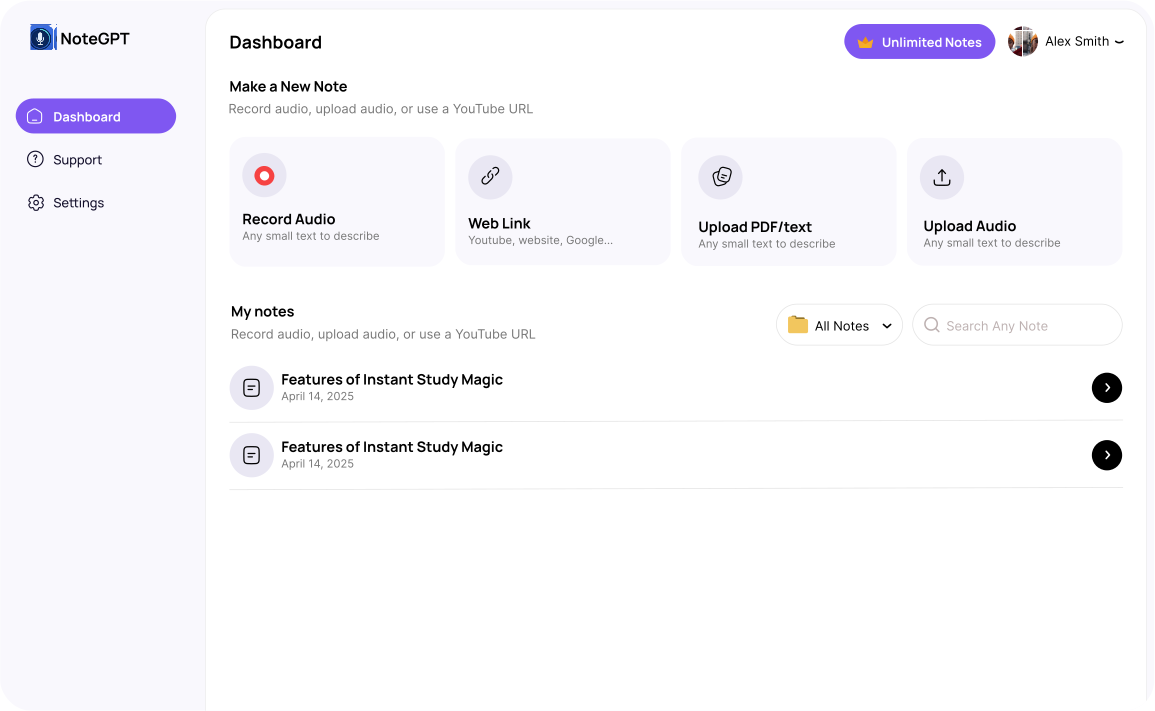
AI note takers in 2026 are no longer just transcription tools. The category has split into a few distinct workflows:
- Live capture: Real-time transcription of lectures, meetings, and study sessions, often with speaker labels.
- Document ingestion: Upload a PDF, slide deck, or YouTube link and the AI extracts and structures the content.
- Automatic study materials: Many student-focused tools now generate flashcards, quizzes, and study guides directly from raw transcripts or source documents.
- Searchable knowledge bases: Tools like NotebookLM let you ask grounded questions across all your notes, transcripts, and uploaded sources.
The shift over the past two years is that “AI note taking” now means an end-to-end study or work system, not a single feature. The best tools cover capture, summarization, organization, and review materials in one place.
Cornell vs AI notes: the head-to-head
Here’s how the two approaches compare across the dimensions that actually matter for studying and working.
| Dimension | Cornell method | AI note takers |
|---|---|---|
| Speed of capture | Limited to how fast you can write or type | Real-time transcription, near 100% of what is said |
| Retention and recall | Strong, by design | Weak unless paired with active review |
| Effort during session | High, requires active listening and summarizing | Low, the tool captures everything |
| Effort after session | Moderate, cues and summary need to be written | Low, summaries and study materials are auto-generated |
| Accuracy | Filtered through your own understanding | Very high for what was said, but no comprehension |
| Collaboration | Manual sharing | Shared transcripts, comments, searchable team notes |
| Privacy | Fully private, paper or local file | Varies, cloud storage and bot-based capture raise concerns |
| Cost | Essentially free | Free tiers exist, but full features usually $10 to $30 per month |
| Best for | Learning, exam prep, deep reading | Lectures, meetings, research review, fast capture |
Where Cornell wins
Cornell is the better choice when the goal is comprehension and long-term retention, not just having a record of what happened.
The cue column does the work that matters: it forces you to convert raw notes into questions, which is exactly the format your brain needs for retrieval practice. Writing “Mitosis has 4 phases” in your notes and then writing “Name and describe the 4 phases of mitosis” as a cue creates a built-in self-test you can run whenever you review.
The summary section adds a second layer. Forcing yourself to distill an hour of material into two or three sentences in your own words is a synthesis exercise. You can’t write a coherent summary of something you don’t understand, so the summary acts as a comprehension check.
When Cornell is the right tool: exam prep, learning a new domain, reading dense material, any situation where the test is “do I remember and understand this in two weeks.”
This is why Cornell has stayed relevant for 70 years across schools, universities, and professional training programs. The format is simple, but the cognitive workout it forces is hard to replicate with passive note-taking, no matter how clean the output looks.
Where AI notes win
AI notes win on every dimension that involves volume, speed, or retrieval after the fact.
If you’re sitting in a fast-paced lecture, taking three classes a day, attending back-to-back meetings, or trying to synthesize a stack of research PDFs, the bottleneck isn’t comprehension. It’s capacity. You physically cannot write down everything that matters, so you make tradeoffs in real time, and some of those tradeoffs cost you later when you realize you missed an important detail.
AI removes that tradeoff. The transcript captures everything. The summary gives you the main points. The auto-generated flashcards or quizzes give you a starting point for review. Recent comparisons of AI note-taking apps show that the strongest tools for students are now built around this full pipeline rather than transcription alone.
When AI is the right tool: long lectures, recorded courses, meeting-heavy workdays, literature reviews, anything where missing information is worse than information overload.
The catch is that having a transcript is not the same as learning the material. AI gives you the raw material in higher fidelity than you could capture yourself, but it doesn’t process the material for you. That’s where the hybrid model comes in.
The hybrid workflow that beats both
The most effective system in 2026 is not to pick one approach. It’s to use AI for first-pass capture and Cornell for second-pass learning.
Here’s what that looks like in practice for a student.
Step 1: Capture with AI during the lecture
Run an AI note taker in the background. Don’t try to take detailed notes yourself. Focus on listening and write down only the things you want to flag for later: questions you have, things that surprised you, points the lecturer emphasized.
Step 2: Get the AI summary and transcript
After class, pull up the AI-generated summary and full transcript. Skim the summary to confirm it captured the main points. Use the transcript to check anything that’s unclear.
Step 3: Convert to Cornell layout within 24 hours
Open a new Cornell page (paper or digital). In the notes column, write down the key concepts in your own words, working from the AI summary and your in-class flags. This is the step that turns passive information into active understanding.
Step 4: Write cue questions
For each block of notes, write at least one question in the left column. Make them specific. “What are the four stages of mitosis and what happens in each?” is a better cue than “mitosis.”
Step 5: Write the summary
In two or three sentences at the bottom, capture the lecture’s main argument in your own words. If you can’t, that’s a signal you need to go back to the transcript.
Step 6: Review with active recall
Cover the notes column and test yourself against the cues. Do this on a spaced schedule: day 1, day 3, day 7, day 14. This is where retention actually happens.
Why this hybrid works
- AI handles the high-bandwidth, low-thought work of capture.
- Cornell handles the lower-bandwidth, high-thought work of synthesis and recall.
- You stop trying to do both at once, which is what causes most note-taking systems to fail.
Use cases: which approach fits which user
Students preparing for exams
Cornell-heavy hybrid. Use AI for lecture capture, but spend the bulk of your time in the Cornell phase. The cues and summary are doing the work that exam prep actually requires. If a tool also generates flashcards, feed those into a spaced-repetition app like Anki for an extra layer.
Researchers and graduate students
AI-heavy hybrid. Volume of source material is the bottleneck, so lean on AI tools that ingest PDFs and let you query across sources. Use Cornell selectively for the readings you need to genuinely understand, not just reference.
Meeting-heavy professionals
Mostly AI, with light Cornell for high-stakes meetings. For routine status meetings, AI summaries and action items are enough. For strategic meetings where the decisions matter for months, take five minutes after the meeting to write a Cornell-style summary with cue questions about what was decided and why.
Content creators and writers
Hybrid. AI for interview transcripts and research capture, Cornell-style synthesis for converting raw material into your own structured thinking. The summary section is especially useful here because it forces you to find your own angle.
Self-directed learners
Cornell-first. If you’re learning something for yourself rather than for a test or job, retention is the entire point. AI can help with capture from videos and books, but the Cornell layer is where the learning happens.
The biggest mistakes people make
Mistake 1: Using AI notes as a substitute for review
Having a perfect transcript feels like learning, but reading a transcript is passive. If you stop at AI capture and never convert the material into questions you test yourself on, you’ll forget most of it within a week.
Mistake 2: Trying to do Cornell perfectly during a fast lecture
Cornell during a live lecture is hard. You’re listening, deciding what’s important, summarizing on the fly, and trying to leave space for cues you’ll write later. Most people end up with messy notes and no cues. Capture with AI, format with Cornell after.
Mistake 3: Skipping the 24-hour window
The Cornell method works because you process the material while it’s still fresh. Wait a week and you’re not creating cues from memory, you’re decoding your own bad handwriting. Block 15 minutes within a day of every lecture.
Mistake 4: Treating AI summaries as the final product
AI summaries are starting points, not endpoints. They tell you what was said, not what matters or what you didn’t understand. You still need to do the thinking.
A practical decision rule
The one-line answer
Use Cornell when memory matters most. Use AI when capture volume matters most. Use the hybrid when both matter, which is most of the time for serious students and knowledge workers.
The 2026 winner isn’t a single method. It’s a system: AI for speed, Cornell for retention.
Frequently asked questions
Is the Cornell method still relevant in 2026?
Yes. The Cornell method is built around active recall, which remains one of the best-supported learning techniques in cognitive research. The format is 70 years old, but the underlying principle, that testing yourself beats rereading, has only become better established over time.
Can AI note takers replace the Cornell method?
Not for learning. AI can replace the capture and summarization steps, but it can’t replace the active recall practice that makes Cornell effective. You still have to test yourself against cues for the material to stick.
Which AI note takers work best for students?
Student-focused tools like NotebookLM, Otter, and various dedicated study apps lead in 2026. The strongest options handle audio, PDFs, and YouTube videos, and produce flashcards or quizzes rather than just transcripts. Pick based on your main input source: live lectures, recorded videos, or text documents.
Is there a Cornell-style template inside AI note-taking apps?
Some apps offer Cornell templates, but most don’t. The simplest hybrid setup is to use any AI tool for capture, then manually paste the key points into a Cornell layout in Notion, Google Docs, or a paper notebook.
How long should the summary section be?
Two to three sentences. The point is forced synthesis, not comprehensive coverage. If your summary is a paragraph, it’s not doing the work it’s supposed to do.
What if I take notes by hand but want AI features too?
Most modern tools support audio capture even if you’re handwriting notes. Record the session with an AI app running in the background, write your Cornell notes by hand, then use the AI transcript afterward to fill in anything you missed.
Does the Cornell method work for technical subjects like coding?
Yes, with adjustments. The notes column can hold code snippets and concepts. The cue column works well for problem statements: “How do you reverse a linked list?” The summary forces you to articulate what a concept is for, not just how it works.
How much time does the hybrid workflow actually take?
For a one-hour lecture, expect 10 to 20 minutes of post-class work to convert AI output into Cornell format. That sounds like a lot until you compare it to the alternative: re-watching the lecture or cramming the night before the exam.