
Most AI note tools promise the same thing: paste in your messy notes, get back a clean summary, and study less. That part is mostly true. The catch is that a tidy summary can give you a false sense of mastery.
You read something an AI wrote, it feels familiar, and you mistake recognition for real understanding. The fix is not to avoid these tools, it is to build a repeatable routine where AI does the sorting and surfacing while you keep doing the thinking that actually makes knowledge stick.
This guide lays out a daily workflow you can start tomorrow. It has two halves that feed each other: a lightweight daily notes loop that captures everything, and a focused deep-study loop you trigger when an exam, essay, or project demands real depth. Both end in study-ready material: summaries you trust, flashcards you can drill, and review prompts that keep old topics from fading.
Why a daily system beats last-minute cramming
Cramming works against how memory forms. Information you meet once, the night before, decays fast. Information you capture, revisit, and re-encode over days settles into long-term memory.
A daily AI notes loop is really a spaced-repetition habit in disguise: small, frequent touches with your material instead of one panicked marathon.
AI earns its place here by removing the boring friction. Sorting notes into themes, turning a bare link into a labeled source, drafting a first round of flashcards, spotting which topics you keep circling back to: these are exactly the tasks that drain motivation and that a model handles in seconds. Your job is the higher-value part, deciding what matters, testing yourself, and writing in your own words.
Part 1: The daily capture layer
The goal of capture is simple. Never lose an idea, a question, or a useful source, and never break your focus to file it neatly. Structure comes later; capture should be frictionless.
Pick one quick-capture home and use it all day. Apple Notes, Google Keep, OneNote, Notion, or Obsidian all work. What matters is that it opens in one tap on whatever device is closest. Create a single rolling note called something like “Inbox, Today” and dump into it without organizing:
- Raw ideas and questions that surface in lectures, readings, or study chats.
- Quotes, screenshots, diagrams, and URLs you want to come back to.
- Half-formed hypotheses (“does this theory contradict last week’s reading?”).
- Anything a teacher stressed or repeated, flagged with a quick star or tag.
Keep it deliberately messy. The whole point is that capture takes two seconds so you actually do it. If you record lectures, an AI transcription tool such as Otter can sit alongside this layer and hand you a clean transcript afterward, which becomes another source you drop into the inbox.
Tip: One inbox, not five. The fastest way to abandon a notes system is to scatter captures across too many apps. Resist the urge to file in the moment. The evening pass is where filing happens.
Part 2: The evening processing pass
Once a day, ideally at the end of your study block, spend 15 to 20 minutes turning the day’s inbox into something useful. Copy the entire “Inbox, Today” note into an AI workspace (ChatGPT, Claude, Gemini, or an AI-enabled note app) and ask it to do the sorting you skipped during the day.
Example prompt: evening cleanup Here are my raw notes from today. Do three things. 1) Cluster them into themes and label each cluster. 2) Pull out any action items or open questions as a checklist. 3) Turn any bare URLs into a labeled source list. Do not add facts that are not in my notes. Keep it concise.
From that cleaned-up output, ask for two short artifacts you can save back into your notes system:
- A Daily Brief: five to ten bullets summarizing what you learned or noticed today.
- A Seed Questions list: the open questions worth chasing later, each tied to the topic that prompted it.
Paste both back into your notes app so everything stays searchable in one place. Apps built around AI organization, such as Mem, can automate the clustering and linking step for you, surfacing related older notes as you go. The principle holds either way: end every day with structured, searchable material instead of a wall of raw text.
Part 3: Deep study sessions, turning sources into understanding
The daily loop keeps ideas flowing. When something real is at stake, an exam, a graded essay, a research project, you switch to the deep-study loop. This is where source-grounded AI tools shine, because they answer only from material you give them rather than guessing.
Step 1: Write a tight study brief
Before you open any tool, define what you actually need to learn. In your notes, create a short brief with the working topic, three to five core questions you must be able to answer, and any constraints (a specific syllabus, a date range for sources, a required reading list). A vague goal produces vague output; a sharp brief produces focused study material.
Step 2: Build a source-grounded notebook
Load your lecture slides, textbook chapters, transcripts, and assigned papers into a tool that answers from your own documents and cites them. Google’s NotebookLM is the standout here for students: its free tier is generous, it grounds every answer in your uploaded sources, and you can click any claim to verify it against the original material. That citation behavior matters, because it means no invented facts slipping into your study notes.
Example prompt: source-grounded study Using only the sources I uploaded, write a structured study memo for [topic]. Use these sections: core concepts, key definitions, worked examples, common misconceptions, and likely exam questions. Cite which source each point comes from. Flag anything the sources disagree on.
NotebookLM and similar tools can also turn dense material into an audio overview, a short conversational recap you can listen to while walking to class. Used for review, that is genuinely effective. Used as a substitute for reading, it is a shortcut that will cost you on test day.
Step 3: Break it into atomic notes
Take the memo and ask AI to split it into atomic notes: one concept or claim per note, each in plain language. Tag and link them by topic. In a tool like Obsidian, which stores everything as local Markdown files you fully own, you can build a connected web of these notes that grows across the whole semester instead of resetting with every assignment. The one-off study session becomes reusable knowledge.
Step 4: The verification pass
AI tools that are not grounded in your sources can still get numbers, dates, and definitions wrong. Before you commit anything to memory, run one focused check on the high-stakes details. For every formula, date, definition, or figure you plan to rely on, confirm it against the original source, your textbook, lecture slides, or the assigned reading. When something feels off, re-query with a narrow question rather than a broad one.
Why this step is non-negotiable: A single wrong definition that you drill into flashcards will be wrong every time you review it. Verifying once, up front, protects every study session after it.
Part 4: From notes to study assets
Now you have trustworthy material. This is where AI turns it into things you can actively study with, which is the part that builds real recall.
Summaries you can trust
- Ask for a one-page summary, then a single-paragraph summary, then a one-sentence version. Compressing the same idea at three levels forces clarity and reveals what you do not yet understand.
- Always work from your verified notes, not the open web, so the summary stays grounded in your actual course material.
Flashcards and quizzes
- Have the tool generate question-and-answer flashcards from your atomic notes. NotebookLM can auto-build flashcards and practice quizzes directly from your sources, and many study tools export to Anki for spaced repetition.
- Ask for a short practice quiz, then take it before reading the answers. Retrieval, pulling the answer from memory, is what cements it. Reading a summary feels productive but does far less.
Example prompt: active recall From these notes, write 10 short-answer questions that test understanding, not just recall of definitions. Do not include the answers yet. After I attempt them, grade my responses against the notes and point out exactly where I was vague or wrong.
Outlines for essays and projects
- Feed your brief plus your verified notes to a writing model and ask for two or three different outline angles. Pick one and adjust it by hand.
- Instruct the model to leave placeholders such as [ADD MY OWN ANALYSIS HERE] so the thinking and the final words stay yours. This keeps the work honest and is the line most academic integrity policies care about.
Part 5: Daily and weekly review rituals
A system you do not revisit is just a graveyard of notes. Two short rituals keep it alive.
Daily review (about 10 minutes)
- Prompt your AI on today’s Daily Brief plus any active study notes to surface the top three things to prioritize tomorrow.
- Ask it to pull five quick review questions from material you studied two or three days ago. This is your built-in spaced repetition.
Weekly review (about 30 to 45 minutes)
- Run AI over the full week of notes and ask: which themes came up repeatedly? That tells you where the course is heading and where exams tend to focus.
- Ask which topics now have enough depth to be exam-ready, and which are still thin and need more sources.
- Ask what contradictions or open questions remain, then turn the most important one into next week’s study brief.
Done consistently, these reviews mean your knowledge compounds week over week instead of being relearned from scratch before every test.
Choosing your stack
You do not need a sprawling toolkit. A lean setup covers everything above. The table below maps each job to a simple option and a power-user option so you can start small and add only what you actually miss.
| Job | Simple option | Power-user option |
|---|---|---|
| All-day capture | Apple Notes, Google Keep, or OneNote | Notion or Obsidian as a single inbox |
| Lecture transcription | Phone voice memo plus manual notes | Otter for auto transcripts and summaries |
| All-in-one capture to study materials | NoteGPT free trial to record and auto-summarize | NoteGPT paid plan for unlimited transcripts, flashcards, and quizzes |
| Evening cleanup | ChatGPT, Claude, or Gemini on pasted text | Mem for automatic organization and linking |
| Source-grounded study | NotebookLM free tier | NotebookLM Pro for higher limits and more notebooks |
| Connected knowledge base | Topic folders in your notes app | Obsidian with local Markdown and AI plugins |
| Active recall | AI-generated quizzes you self-grade | Flashcard export to Anki for spaced repetition |
A few notes on the tools, since costs and free tiers shift often.
NotebookLM keeps a genuinely capable free tier that suits most students, with paid tiers available through Google’s AI plans (and a student discount in some regions) if you outgrow the daily limits. Obsidian’s core app is free and stores notes locally, though its AI plugins usually expect you to supply your own API key.
Notion’s free plan is solid for capture and organization, but its full AI features now sit on higher paid tiers, with students and educators eligible for a free Plus plan. Mem leans into automatic AI organization and is best once your note volume is large enough to justify it.
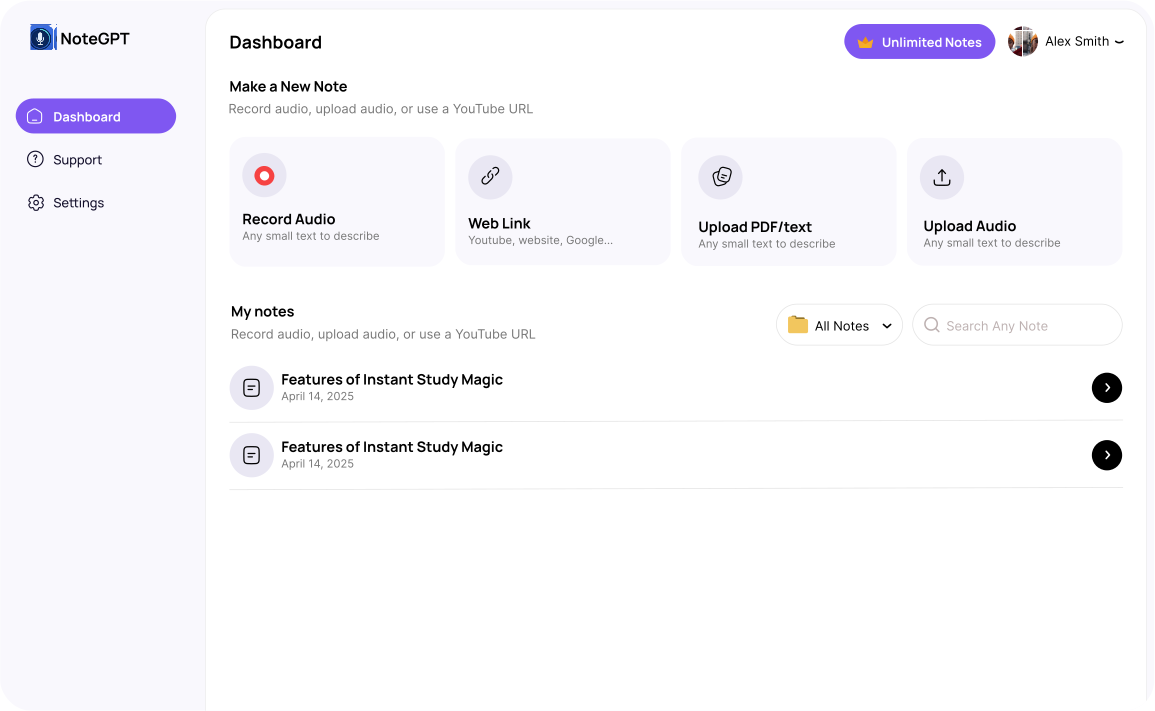
NoteGPT bundles several of these jobs into one app: it records and transcribes lectures, summarizes audio, video, PDFs, and web pages, and auto-generates flashcards and quizzes, with a free trial to test it before you pay.
Always check current pricing on each tool’s own site before committing, since these plans change frequently.
If you are starting fresh, the highest-leverage pair is NotebookLM for source-grounded study plus one daily-driver chat model (ChatGPT, Claude, or Gemini) for cleanup and quizzes. Add a dedicated notes app like Obsidian only once you feel the need for a connected, long-term knowledge base.
A sample daily schedule
Here is how the whole loop fits into a normal study day. Adjust the times to your own rhythm; the sequence is what matters.
All day: dump every idea, question, quote, and link into your single “Inbox, Today” note. No filing, no editing.
During a class or focused block: load that session’s slides and readings into NotebookLM, ask for a source-grounded study memo, run the verification pass on key facts.
Late afternoon (15 to 20 min): run the evening cleanup prompt on today’s inbox. Save the Daily Brief and Seed Questions back into your notes.
Before you finish (10 min): generate five review questions from material you studied two or three days ago and answer them from memory.
Once a week (30 to 45 min): run the weekly review, identify exam-ready versus thin topics, and set next week’s study brief.
The first week feels like overhead. By the second, the inbox-to-brief habit is automatic, and you walk into exams with a stack of verified summaries and self-tested questions instead of a blank page and a long night ahead.
Frequently asked questions
Is using AI to make study notes considered cheating?
Using AI to organize, summarize, and quiz yourself on your own course material is a study aid, much like a tutor or a study group. The line most schools care about is whether the final graded work is your own thinking and your own words. Using AI to sort notes and generate practice questions is fine; submitting AI-written essays as your own is not. When in doubt, check your institution’s academic integrity policy.
Which AI note tool is best for students on a tight budget?
NotebookLM is the common recommendation because its free tier is unusually generous and it grounds answers in your own uploaded sources. Pair it with the free tier of a chat model and Obsidian’s free core app, and you can run the entire workflow without paying for anything.
Will AI summaries replace actually reading the material?
No, and treating them that way is the main risk. Summaries and audio overviews are excellent for review after you have engaged with the source, but they cannot build the deep familiarity that reading and self-testing produce. Use them to reinforce learning, not to skip it.
How do I stop AI from giving me wrong information in my notes?
Two habits handle most of it. First, prefer source-grounded tools that answer only from documents you upload and that cite their claims. Second, run a verification pass on every number, date, and definition before you memorize it, checking against your textbook or lecture materials. Verifying once, up front, keeps errors out of every later review.
How long before this system actually saves me time?
Expect the first three to five days to feel like extra work while the habits form. After that, the daily cleanup takes 15 to 20 minutes and replaces hours of disorganized rereading later. The real payoff shows up at exam time, when your material is already summarized, verified, and turned into practice questions.