
Most students record lectures and never listen back. The audio piles up, the exam comes, and the notes get re-read at 1am hoping something sticks.
Re-reading is one of the least effective things you can do for memory, yet it stays the default because it feels productive.
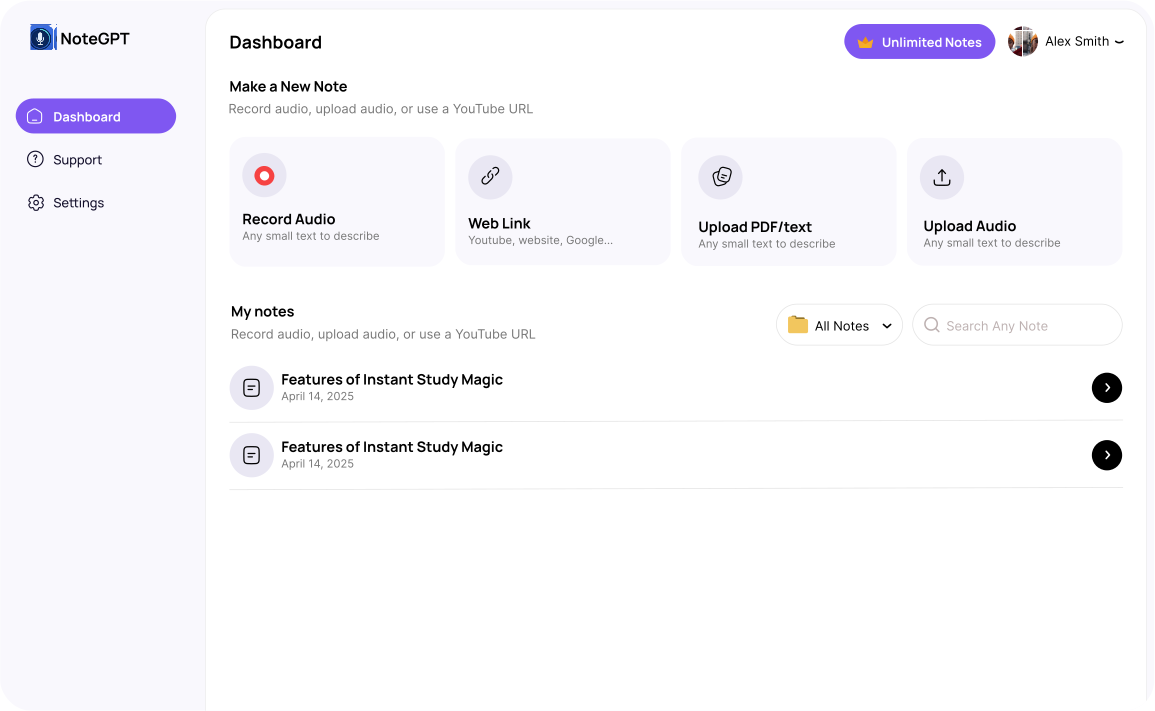
An AI summary note taker fixes the capture problem. It turns a 90-minute lecture into a clean, searchable transcript in minutes.
But the transcript is the start, not the finish. The real gain comes from a repeatable workflow: record, clean up, extract what matters, validate it, then turn it into study material your brain will actually keep.
This guide walks through that workflow step by step, with the tools and study techniques worth using in 2026.
Why an AI note taker beats manual note-taking for studying
Manual note-taking forces a tradeoff. Write fast and you miss the explanation. Listen carefully and you have nothing to review.
Typing verbatim seems like a fix, but a well-known Princeton study found laptop note-takers who transcribed lectures verbatim scored worse on conceptual questions than students who wrote by hand and summarized in their own words.
AI note takers solve that tradeoff. The tool handles capture so you can listen, ask questions, and think. Afterwards, you get a transcript, a summary, and in many tools, automatically generated flashcards or quizzes. Modern student note-taking apps in 2026 cover four workflows: live lecture capture, PDF or textbook study, iPad handwriting, and flashcards with spaced repetition.
The shift matters because studying is no longer about owning the cleanest notes. It is about turning recorded material into active retrieval practice.
The 6-step AI note taker workflow for smarter studying
Step 1: Record the lecture properly
Audio quality decides transcription accuracy. Garbage in, garbage out applies more to AI than to human note-takers. A few habits make a real difference:
- Sit in the front third of the room or close to the speaker if it is a recorded class.
- Use a phone with a decent mic, ideally with a small clip-on lavalier if you can afford one.
- Record to a standard format (MP3, M4A, or WAV) so any tool can read the file.
- Test levels for 30 seconds before the lecture starts. Background noise, fans, or echo will hurt accuracy more than accent.
For online classes, capture system audio directly if the tool supports it. Apps that support system-level audio capture let you record a meeting without an awkward AI bot joining the participants, which matters for both privacy and clean audio.
Step 2: Transcribe with an AI tool that fits the use case
There are two camps in the AI note taker space right now, and the difference matters more than the marketing suggests. Half the “best AI note-taking apps” articles are actually meeting-transcription tools repurposed for students. They are good at capture but they do not help you study the content. The other half are learning-focused tools that generate study material from the notes: flashcards, quizzes, summaries, Q&A.
For studying, you want both, or one tool that does both well.
| Tool | Best for | Why it works for students |
|---|---|---|
| NoteGPT | All-in-one summary note taker for students | Summarizes lectures, YouTube videos, and PDFs into structured notes, then generates flashcards and quizzes from the same upload |
| Otter.ai | Live lecture capture | Real-time transcription, OtterPilot captures slides automatically, strong mobile app |
| NotebookLM (Google) | Research-heavy classes | Source-grounded answers across transcripts, PDFs, and notes. Free, no credit card. |
| PolarNotes AI | End-to-end student workflow | Lectures, PDFs, and YouTube videos in, structured notes and study aids out |
| RemNote | Memorization-heavy subjects | Converts notes into atomic flashcards with built-in spaced repetition |
| NotebookLM + Anki | Free, robust setup | NotebookLM for summarization, Anki for the gold-standard spaced repetition engine |
Source-grounded tools matter more than raw capability. The main risk with reading mode is hallucination, and source-grounded tools cite the passage they drew from so you can verify before studying. Studying from a hallucinated fact is worse than not studying at all.
Step 3: Clean and label the transcript
Raw transcripts are messy. Fillers, mislabeled speakers, occasional misheard technical terms. Five to ten minutes of cleanup turns a wall of text into something you can actually study from.
- Choose a style. For studying, clean verbatim (fillers removed) almost always wins. Keep verbatim only if exact phrasing matters, like a quote from a guest speaker.
- Fix speaker labels. Most tools label the professor as “Speaker 1” by default. Rename to “Professor,” “Student Q,” and so on so the conversation reads naturally.
- Correct technical terms. Spot-check anatomy terms, formulas, named theorems, or proper nouns. These are where AI transcripts fail hardest.
- Add light structure. Drop H2 or bold lines at every topic shift, and timestamp anything you might want to revisit in the audio.
Editorial Tip
If you are studying foreign-language content or a heavily accented lecturer, do this cleanup pass with the audio playing alongside. AI accuracy drops on accents and jargon, and a fast verify-and-fix pass beats discovering the error during exam revision.
Step 4: Extract themes, key concepts, and questions
This is the step most students skip, and it is the step that produces the biggest grade lift. You are mining the transcript for what will actually appear on the exam.
- Skim once and write 5 to 10 core themes or concepts the lecture covered. Definitions, frameworks, named processes, contrasts, exceptions.
- Tag passages against those themes. You can do this in Notion, Obsidian, or directly in the transcript with bold or highlight.
- Pull 2 to 3 sharp quotes or worked examples per theme with timestamps. Useful for essay subjects and case-based exams.
- Flag claims to verify. Specific dates, statistics, study citations, or “the only X that does Y” statements. Mark these for the next step.
The output is a one-page “insight sheet” per lecture: themes, concepts, examples, and a list of things to validate. That sheet, not the full transcript, is what you study from.
Step 5: Validate facts with up-to-date sources
AI tools make mistakes, lecturers occasionally simplify, and textbooks lag the field. For anything that will affect an exam answer, verify against a current source.
- Turn each flagged claim into a tight search query. Add the year or “latest” when freshness matters (medication guidelines, software versions, case law, market data).
- Prioritize primary sources: official documentation, peer-reviewed papers, government statistics, the textbook itself. Treat secondary blogs and AI outputs as starting points only.
- Keep a short research log per lecture: claim, source URL, date, one-line summary. This becomes your citation bank for essays and saves you from rebuilding the same searches twice.
- Use AI deep-research features as a synthesis layer, then click through to the underlying source before trusting specific numbers.
Step 6: Turn the transcript into active recall material
This is where the workflow pays off. Re-reading the transcript will not get you through the exam. Converting it into active recall practice will.
The evidence on this is unusually strong. Research by Roediger and Karpicke (2006) showed that students who used retrieval practice scored 50% higher on delayed tests than students who re-studied. The combination of retrieval and spaced intervals produces dramatically better long-term retention than any passive study method. Active recall produces 50 to 150% better long-term retention than passive methods because it creates stronger memory traces through effortful retrieval.
Three practical conversions from transcript to study material:
1. Flashcards from key concepts
Feed your insight sheet into a tool like RemNote, Anki, or PolarNotes AI. Aim for atomic cards: one fact, one definition, one cause-effect per card. Avoid cramming three concepts onto one card, the spaced repetition engine cannot grade you fairly on a card that asks five things.
2. Practice questions from themes
Most learning-focused note takers auto-generate practice questions from your notes. Paste key concepts into a tool like NotebookLM or RemNote and generate practice questions, then answer without looking and mark anything you got wrong. Schedule wrong-answer cards for spaced repetition before the exam. The wrong-answer cards are where the real learning happens.
3. Free recall summaries
After each lecture, close the transcript and write a one-page summary from memory. Then compare to your insight sheet. Summarization that requires active retrieval, not copying while looking, produces stronger retention than passive summarization. The gaps between your summary and the sheet are exactly where to focus.
How to space your reviews so the material actually sticks
Active recall on its own is good. Active recall on a spaced schedule is exceptional. The principle: review material at increasing intervals, just before you would otherwise forget it.
A simple schedule that works for most courses:
- Day 1: Do the workflow above immediately after the lecture. Transcript, insight sheet, first flashcard pass.
- Day 2: 10-minute flashcard review. Focus on cards you got wrong.
- Day 7: Second pass. Add new cards for anything that came up in the next lecture and built on this one.
- Day 14: Third pass. By now most cards should feel routine. Mark anything still shaky for daily review.
- Pre-exam: Full deck review at decreasing intervals as the date approaches.
Anki, RemNote, and most modern student-focused tools handle this scheduling automatically. You answer the cards, the algorithm decides what you see and when.
Common mistakes that waste the workflow
- Skipping the cleanup pass. Raw transcripts are too noisy to study from. The five minutes of cleanup pays back tenfold during revision.
- Studying from the transcript directly. Re-reading a transcript is the same passive review that does not work with handwritten notes. Always convert to active recall material.
- Making cards too big. One card, one fact. Big cards train you to recognize patterns, not retrieve information.
- Trusting AI summaries blindly. Source-ground everything that matters. Hallucinated facts are studied just as efficiently as real ones, with terrible exam consequences.
- Recording everything and reviewing nothing. The transcript is not the work. The retrieval practice is.
Quick-reference workflow table
| Stage | Goal | Output |
|---|---|---|
| Record | Clean audio from the lecture | MP3 or M4A file, ideally with slides captured separately |
| Transcribe | Fast, accurate text from audio | Editable transcript plus timecoded version for revisits |
| Clean and label | Readable, analyzable document | Speaker-labeled transcript with light structure |
| Extract themes | Find the concepts that matter | One-page insight sheet with themes, quotes, and flags |
| Validate | Confirm facts and dates | Short research log with sources for each flagged claim |
| Convert to active recall | Build study material | Flashcards, practice questions, and free-recall summaries |
FAQ
Is using an AI note taker considered cheating?
No. AI note takers transcribe what was said in a lecture you attended, the same way a recorder would. Cheating becomes an issue if you use AI to generate work you submit as your own. Check your institution’s policy on recording lectures, since some require explicit consent from the lecturer.
Can AI note takers handle technical subjects like medicine or engineering?
Yes, but accuracy on technical vocabulary varies. Always verify drug names, formulas, and named processes against the audio or a primary source. Tools that let you upload a glossary or course PDF tend to perform better on jargon because they ground transcription in your specific vocabulary.
How long does this workflow take per lecture?
For a 60-minute lecture, expect roughly 20 to 30 minutes the first time: 5 minutes of cleanup, 10 minutes of theme extraction, 5 minutes of validation, 10 minutes of building flashcards. After three or four lectures, you will trim that to about 15 minutes. The payoff is hours saved during exam revision because you are reviewing structured cards instead of re-watching lectures.
Do I still need to take notes during the lecture?
Light notes help. Capture diagrams the AI cannot transcribe, questions you want to follow up on, and your own connections to other topics. The AI handles the verbatim record. Your job during the lecture is to think.
What is the single biggest mistake students make with AI note takers?
Treating the transcript as the finished study material. Re-reading a transcript is the same passive habit that fails with handwritten notes. The transcript is raw material. Active recall practice is the study.