
Most students already use AI to summarize a reading or rewrite a messy paragraph. Fewer use it to manage knowledge: to capture material, organize it, research a topic with current sources, and turn all of that into study aids they can actually revise from.
The first habit saves a few minutes. The second changes how an entire semester feels.
Knowledge management with AI is not a single app. It is a small, repeatable system that sits across the tools you already have.
Done well, it cuts the time you spend hunting for that one quote you saved somewhere, keeps your research current instead of relying on whatever a model memorized months ago, and produces flashcards, quizzes, and outlines grounded in your own sources rather than generic internet filler.
This guide walks through a practical, tool-agnostic workflow you can adapt to whatever you use now, whether that is NotebookLM, Obsidian, Notion, or a plain folder of PDFs. Each step is something you can start this week.
Key takeaways
- Knowledge management with AI is a workflow, not a product: capture, organize, research, synthesize, then generate study material.
- The biggest quality lever is grounding. Tools that answer from your own uploaded sources are far more trustworthy than ones answering from general training data.
- Recency matters for fast-moving topics. Use a research step that pulls dated, current sources rather than trusting a model’s memory.
- AI should handle retrieval and structure. The thinking, summarizing, and recall still have to be yours, or retention drops.
- A good starting stack: one place for notes, one tool that reads your sources, and one research helper for fresh information.
What “knowledge management with AI” actually means
Knowledge management is the practice of capturing what you learn, organizing it so you can find it again, and reusing it instead of relearning it from scratch. Students do a version of this every semester, usually badly: notes scattered across apps, screenshots in a camera roll, PDFs in a downloads folder no one ever opens again.
AI improves three parts of that loop. It can organize and classify notes automatically using language understanding, so related ideas cluster together without manual tagging. It can extract concepts and relationships, so you can later ask questions like “show me everywhere these two ideas connect.”
And it can keep material fresh by summarizing long sources on demand and pulling current information when you need it.
The catch is that AI is only as good as what you feed it. A model answering from its general training data will sound confident and occasionally be wrong. A model answering from your lecture slides, your assigned readings, and your own notes is far more reliable, because every answer traces back to a source you can check.
That principle, called grounding, runs through the entire workflow below.
The five-step workflow
1. Define your study unit
Before touching a tool, decide what a complete package looks like for a single topic. Think of it as one self-contained folder or note for each exam topic, essay, or project. A good study unit holds:
- A short statement of what you need to understand and why (the exam question, the essay angle, the concept you keep getting wrong).
- A bullet list of the questions your material has to answer, for example “What is this theory?”, “What is the strongest counterargument?”, “Which examples appear most in past papers?”
- A list of must-use sources: your lecture notes and slides, the assigned readings, and two or three reputable outside sources to fill gaps.
Save this as a reusable template in your note app and create one copy per topic. That note becomes the hub everything else hangs off, which keeps your research from sprawling into twenty open tabs.
2. Build a knowledge base AI can actually read
Your notes only help if a tool can retrieve and synthesize them. Three things make that possible:
- One source of truth. Pick a single home for notes, whether that is Obsidian, Notion, or a structured set of documents. Spreading the same topic across five apps defeats the point.
- A capture inbox. Have one obvious place to drop raw material: lecture recordings, PDFs, web clippings, screenshots. You will process it later, but it should never get lost first.
- Light structure. Tags and links around recurring themes (“cell respiration,” “WWI causes,” “supply and demand”) help both you and any AI tool surface the right material quickly.
Tools that connect AI directly to your own documents are the centerpiece here. NotebookLM, for instance, lets you load a topic’s sources into a single notebook and then ask questions, generate summaries, and build study guides that pull only from those sources.
Obsidian with a semantic-search or chat plugin can do something similar over a markdown vault you control. The shared idea: stop searching your notes by keyword and start asking them questions.
3. Run deep, up-to-date research
For anything that changes (a current debate, recent studies, a fast-moving field) your own notes will have gaps. This is where a research step earns its place.
Modern “deep research” assistants such as Gemini Deep Research and similar tools are built to break a question into sub-questions, search multiple current sources, and return a synthesized answer with links you can open. Used well, the workflow looks like this:
- Give the assistant your study unit and constraints, for example: “Research the main causes of the 2008 financial crisis. Prioritize sources from reputable outlets and academic work, and include a publication date and link for each claim.”
- Ask for specific outputs: a structured outline, a table of key facts with dates, and a short list of recent developments, each with its source URL.
- Paste the result into your study unit as a “raw research” note, keeping every link. This is reference material, not a finished answer.
Mix your sources on purpose A single type of source skews your understanding. Pair explainer articles and tool pages with at least one academic or independent source, so your notes are not just repeating one perspective. For genuinely current topics, include one primary source: an official page, a paper, or an original announcement.
4. Turn raw research into structured knowledge
Raw research is messy. The next step converts it into something you can revise from. A few patterns work well:
- Per-source summaries. For each important reading, write a short note with the same sections every time: main claim, evidence, limitations, and why it matters for your topic. Let AI draft these, then correct them yourself.
- Cross-source synthesis. Ask a tool reading your collected notes, “What patterns repeat across all of these sources?” Save the answer as its own synthesis note. This is often where the real exam-level understanding appears.
- Concept maps. Many tools offer graph or mind-map views that show how ideas connect. These are useful for seeing structure before you write an essay or sit a comprehensive exam.
The point of this step is durability. You are turning disposable web content and lecture audio into reusable assets that live in your own system, independent of any one app.
5. Generate study-ready material
Now the payoff. With grounded notes in place, AI can produce study aids tied to your exact sources rather than to whatever a model happens to know.
Current note tools make this fast. NotebookLM can generate flashcards, quizzes, study guides, and audio summaries directly from your uploaded material, and because they are grounded in your sources, the questions reflect your syllabus rather than a generic version of the subject. You can usually adjust difficulty, number of cards, and focus area.
A reliable sequence for an exam:
- Generate a study guide or outline from your sources to confirm you have full coverage.
- Create flashcards for the facts and definitions you need to recall cold.
- Generate a practice quiz, take it without looking, and note where you fail.
- Send those weak spots back through the loop: reread, re-summarize in your own words, requiz.
Keeping it accurate
An AI workflow is only useful if you can trust the output. Two habits protect you:
Check recency
Filter for recent material when a topic moves quickly, and prefer sources that show a clear publication or update date. A confident answer with no date and no link is a flag, not a fact.
Keep a human in the loop
Make it a rule that every non-obvious claim in your notes traces back to at least one source you have actually read. AI is excellent at retrieval and structure and occasionally wrong about specifics, so treat its summaries as first drafts you verify, not final answers.
The retention trap
There is a real risk worth naming. A tool that hands you a perfect summary of something you never read can quietly replace the part of studying that actually builds memory.
Classic research by Mueller and Oppenheimer found that students who processed and summarized material in their own words retained more than those who simply transcribed it. A beautiful AI-generated transcript or summary can hurt recall if it removes the thinking step.
The fix is to use AI for the heavy lifting around the edges (capturing, organizing, finding, structuring) and to keep the core cognitive work yours. Let it build the flashcards; you still have to answer them. Let it surface the connections; you still have to explain them out loud.
The workflow saves you from busywork so you can spend more time on the part that learning actually requires.
A starting tool stack
You do not need everything at once. Most students do well with one note home, one tool that reads their sources, and one research helper. The table below is a starting point, not a ranking; the best tool is the one you will keep using.
| Role in the workflow | What it does | Examples to consider |
|---|---|---|
| Notes home | One place to store and connect everything, with links and search | Obsidian (free core, AI via plugins), Notion (good for organizing a full semester) |
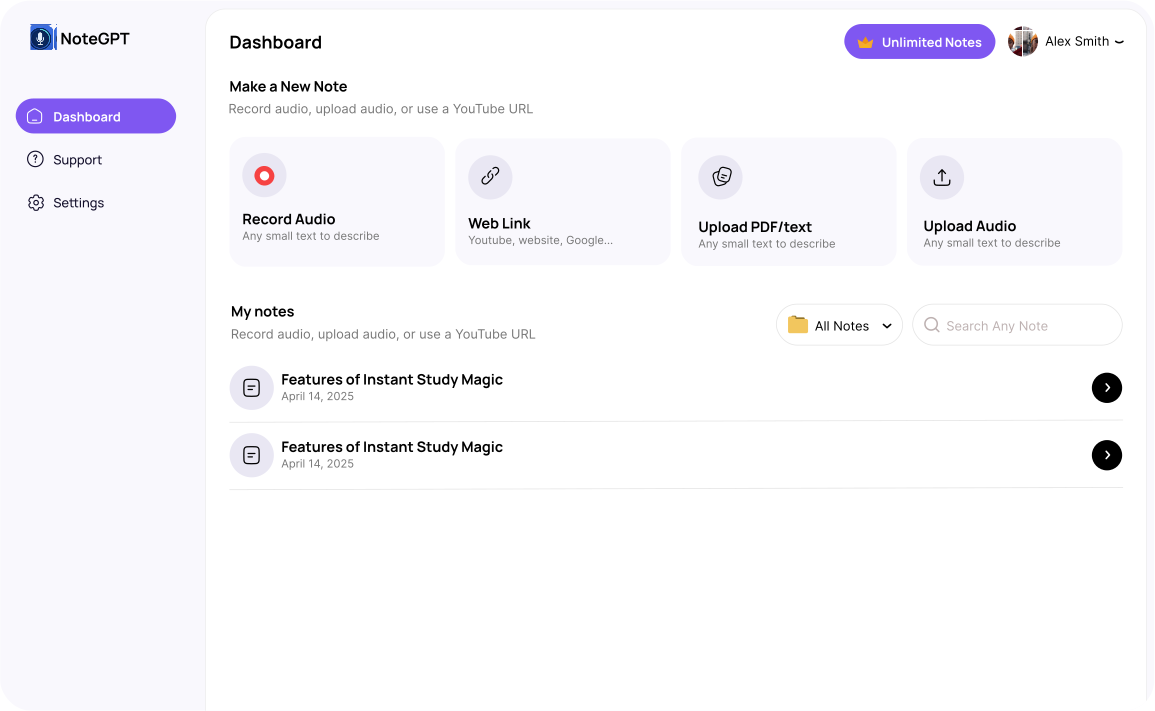
| Source-grounded assistant | Reads your uploaded readings and notes, then answers, summarizes, and builds study aids from them | NoteGPT (summarizes PDFs, videos, and lectures into notes, flashcards, and mind maps), NotebookLM (flashcards, quizzes, study guides, audio summaries) |
| Live capture | Transcribes lectures so nothing is lost, then feeds the text into your system | Otter and similar transcription tools |
| Deep research | Pulls current, dated, cited sources to fill gaps your notes do not cover | Gemini Deep Research and comparable research assistants |
Pricing and free-tier limits on these tools change often, so confirm the current terms before committing. As a rule of thumb, the source-grounded assistant and the notes home are where most of the value sits for everyday studying.
Turning it into a routine
The system only works if it becomes a habit rather than a one-time setup. A simple loop to repeat for each topic:
idea or topic, define a study unit, drop sources into your knowledge base, run a research pass for anything current, synthesize into structured notes, then generate study material and test yourself.
Once that path is familiar, it takes minutes per topic and the quality of your revision rises sharply, because everything you study traces back to a source you trust.
Frequently asked questions
What is knowledge management with AI in simple terms?
It is using AI to help you capture, organize, find, and reuse what you learn, instead of relearning it each time. For studying, that means turning scattered notes, readings, and lecture recordings into an organized base that AI can search, summarize, and turn into study aids.
Which AI tool is best for students?
There is no single best tool, because the roles differ. NotebookLM is strong for working across your own sources and generating grounded study material. Obsidian and Notion are better as a long-term home for notes. Transcription tools handle live lectures. Most students combine one of each rather than relying on a single app.
Is it cheating to use AI for studying?
Using AI to organize material, summarize sources, or generate practice questions is generally a study aid, not cheating, in the same way flashcards or a tutor are. It crosses a line when it submits work as your own or replaces the learning entirely. Check your institution’s policy, and keep the core thinking yours.
How do I stop AI from giving me wrong information?
Use tools that answer from your own uploaded sources rather than from general knowledge, prefer sources with clear dates, and verify any important claim against the original. Treat AI summaries as first drafts to check, not final answers.
Will using AI hurt my memory and retention?
It can, if it replaces the act of processing material yourself. Research suggests students who summarize and rework material in their own words retain more than those who only transcribe it. Use AI for capture, organization, and structure, but keep the summarizing, explaining, and self-testing as your own work.
Do I need to pay for these tools?
Often no. Several capable tools have free tiers that cover most student needs, and core note apps like Obsidian are free for personal use. Paid plans usually add capacity or extra features rather than being required to start, but confirm current pricing before you rely on any tool.