
More than 30 million students at 15,000 institutions across 150 countries submit their work through Turnitin every year. It is, by a wide margin, the most dominant academic integrity platform on the planet. And yet, at least 12 major universities have disabled its AI detection feature entirely.
That contradiction sits at the center of this Turnitin review. I dug into the accuracy data behind the marketing claims, pulled real pricing from public contracts, examined the false positive controversy hitting ESL students hardest, and tested the 2025-2026 product updates, including Clarity (named one of TIME’s Best Inventions of 2025).
Whether you’re an educator deciding if you can trust the AI scores, a student wondering what happens to your paper after you hit submit, or an administrator negotiating a campus-wide contract, this review covers the parts that matter.
Below, I break down each component with real numbers, independent research, and practical recommendations segmented by audience. Turnitin was founded in 1998 and has had nearly three decades to build its dominance. The question in 2026 is whether that dominance still translates to the best product for your institution.
1. AI Detection Accuracy: The 98% Claim vs. Real-World Results
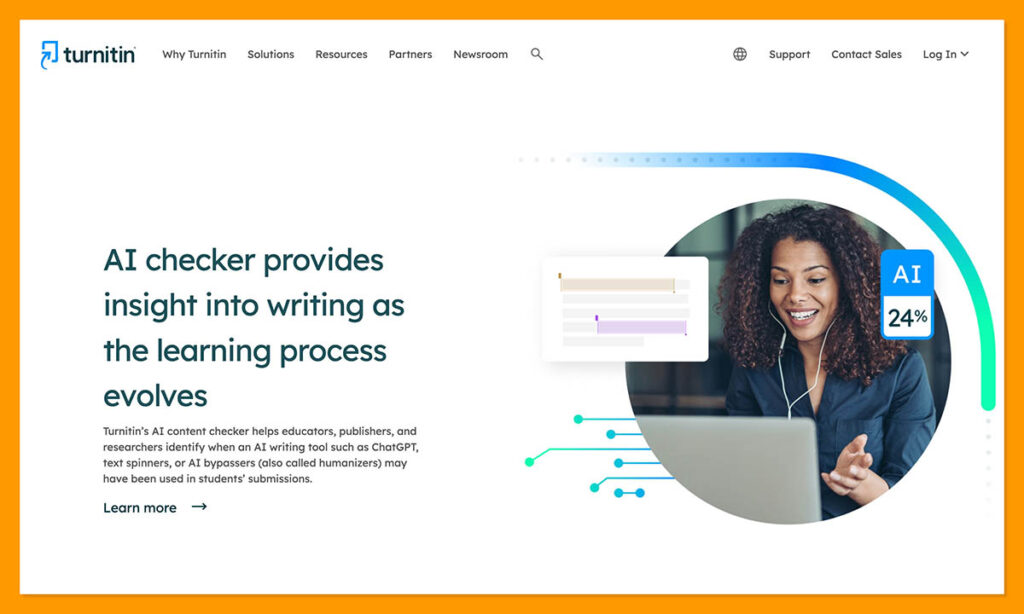
Turnitin markets 98% accuracy for AI detection on documents over 300 words. Their own Chief Product Officer, Annie Chechitelli, told a different story. She acknowledged that Turnitin intentionally lets roughly 15% of AI writing pass undetected to keep false positives below 1%. So which number should you believe?
The answer depends on what kind of content you’re checking.
Turnitin’s detection model uses a transformer-based approach that analyzes three things: perplexity (how predictable the word choices are), burstiness (how much sentence length varies), and long-range statistical dependencies across the text.
Your submission gets split into overlapping chunks of 5 to 10 sentences, each scored from 0 to 1. The system needs at least 300 words to produce a reliable result. Anything scoring below 20% gets an asterisk instead of a number because Turnitin itself considers scores in that range unreliable.
The nuance matters. For pure, unedited AI text from GPT-5 or Google Gemini, detection rates hit 98-100%. That’s genuinely strong. But feed it output from Claude, and accuracy drops to 53-60%. Paraphrased AI content?
Detection falls to 40-70%. Heavily edited AI writing lands between 20-63%. The independent review platform A*Help scored Turnitin 10 out of 10 for detecting pure AI text, but just 1 out of 10 for paraphrased content, giving it an overall score of 66 out of 100.
The August 2025 algorithm update helped considerably. Detection rates for GPT-like content jumped from 75% to over 92%, and false positive rates dropped by roughly 40% based on tests with authentic student submissions.
A Johns Hopkins professor ran a controlled test after the update: 0% AI detected on human-written work, 100% on a pure ChatGPT essay, and correct identification of AI sections in a hybrid essay that was approximately 65% AI and 35% human.
One additional caveat: Turnitin’s own documentation warns that the detector is unreliable for bullet points, tables, annotated bibliographies, poetry, scripts, and code. If your course uses any of these formats, AI detection scores are essentially meaningless for those submissions.
Any honest turnitin review must state this plainly: the tool is strong on unedited AI text from GPT and Gemini, weak on Claude outputs and anything that’s been paraphrased or edited. Treat the AI score as a starting signal for investigation, not as proof.
2. False Positives and ESL Bias: The Elephant in the Room
A student at a Melbourne university wrote a personal teaching reflection about her classroom experience. Turnitin flagged it as AI-generated. It took four months to correct the error. At the University at Buffalo, student Kelsey Auman was falsely accused of using AI despite never touching the technology, prompting her to launch a petition against the system. These are not isolated incidents.
The core technical problem is straightforward. Non-native English speakers tend to use simpler vocabulary, more repetitive sentence structures, and predictable word choices. These patterns overlap significantly with the statistical signatures that AI detectors associate with large language model output. Tools like Grammarly’s rewrite features can also trigger AI flags on entirely human-written text, compounding the problem for students who use legitimate writing aids.
Stanford researchers quantified the damage. In their study, 61.22% of TOEFL essays written by non-native English speakers were misclassified as AI-generated. Roughly 20% of those essays received unanimous false flags across seven different detection tools. Neurodivergent students and those with formal, structured writing styles also face disproportionately higher flag rates.
Turnitin pushes back on these findings. Their internal study of approximately 2,000 ELL samples found a 0.014 false positive rate for English language learners versus 0.013 for native speakers, a negligible difference. Independent research paints a different picture, consistently placing false positive rates for non-native speakers in the 6-25% range depending on the study. Turnitin also acknowledges a score variance of plus or minus 15 percentage points, meaning a 50% AI score could represent anywhere from 35% to 65%.
The institutional response has been dramatic. At least 12 major universities have disabled or restricted the AI detection feature. Johns Hopkins, Yale, Vanderbilt, Northwestern, UCLA, Oregon State, Curtin University, and the University of Waterloo are among them. Vanderbilt was one of the first, citing that Turnitin provides no detailed explanation for how it determines writing is AI-generated. The University of Pittsburgh now requires corroborating evidence and prohibits AI detection scores from serving as the sole basis for misconduct findings.
In this turnitin review, the false positive problem is the single most important risk factor. Approximately 50% of students report being afraid to use AI legitimately in their coursework for fear of being accused of cheating, suggesting the detection regime may deter authorized AI use.
Best for: Institutions with strong appeals processes and policies requiring supplementary evidence alongside any AI detection flag.
Skip if: Your institution has a large ESL or international student population and no formal review process for disputed AI flags.
3. Turnitin Clarity: The Shift From Detection to Transparency
TIME named it one of the Best Inventions of 2025. Turnitin Clarity does something fundamentally different from every other feature on the platform: instead of checking a finished paper for problems, it watches the entire writing process happen in real time.
Students draft their assignments directly inside Clarity’s writing space. When the educator allows it, students can access an AI Assistant that provides feedback on grammar, citations, organization, and argumentation. The critical distinction is that this assistant never writes content for the student. It guides without generating.
On the educator’s side, the view is comprehensive. You see a full timeline of the student’s writing journey: every text addition, every paste event, every request for AI feedback, and every revision. Educators can set AI usage permissions at the assignment level, deciding exactly how much AI assistance students are allowed to use for each task. The AI chat function works in 19 languages, though grammar and citation checks remain English-only for now.
This changes the dynamic between student and instructor. Instead of a post-submission “gotcha” moment, educators can investigate integrity concerns by reviewing the writing timeline. If a student pasted in a large block of text, you’ll see it. If they worked through five drafts over three days, you’ll see that too.
The trade-off is real. Clarity requires students to do their writing inside Turnitin’s environment rather than in Google Docs or Word. That’s a significant ask, and student buy-in is not guaranteed. It also complements the standard Turnitin submission checker rather than replacing it, so institutions running both are adding a layer of complexity.
| Feature | Standard Turnitin | Turnitin Clarity |
|---|---|---|
| When it checks | After submission | During the writing process |
| What it shows | Similarity + AI scores | Full writing timeline |
| AI role | Detection only | Guided feedback (no content generation) |
| Student effort | Submit and wait | Draft inside the platform |
| Educator insight | Final product analysis | Process transparency |
For educators frustrated by the adversarial nature of detection-only tools, Clarity represents the most meaningful shift in Turnitin’s product philosophy since its founding. Any turnitin review that ignores this product misses where the platform is heading.
4. Plagiarism Detection and Database Depth
Before Turnitin became an AI detection story, it built the largest academic plagiarism database on the planet. That database remains its widest competitive moat, and no rival comes close.
The numbers speak for themselves: 99.3 billion indexed web pages, 1.8 billion student papers, over 69 million academic articles and documents, more than 47,000 journals, 56,000 subscription journals from 1,300 publishers, and 135 million open access records through its partnership with CORE. When a student submits a paper, Turnitin compares it against all of these sources simultaneously.
The similarity report uses a color-coded system. Blue means 0-24% similarity, green covers 25-49%, yellow flags 50-74%, orange marks 75-99%, and red indicates 100%. Each matching passage links back to its source, so educators can distinguish between properly cited quotes, common phrases, and actual plagiarism. The system supports Word documents, PDFs, plain text, RTF, and HTML files. Reports typically generate in 15 to 30 seconds when integrated through an LMS.
Citation checking has expanded significantly. Turnitin now covers APA, MLA, Harvard, and Chicago styles, with footnote support added in January 2026. This helps catch improperly formatted citations that contribute to unintentional plagiarism. Students themselves benefit: one student reported that the similarity check caught overlooked uncited quotes from their notes, strengthening the final paper before the grade.
For copy-paste plagiarism (the traditional kind), accuracy sits at 93%. Over 70% of instructors surveyed report that Turnitin has reduced plagiarism incidents in their courses. On the research and publishing side, iThenticate (Turnitin’s product for professional manuscripts) is used by over 1,500 publishers, including Elsevier, Springer Nature, Wiley, Taylor & Francis, and IEEE.
A university processing 75,000 papers annually can queue submissions automatically through LMS integration, with reports available to instructors within 30 seconds. For departments running high-volume courses, that throughput matters.
For traditional plagiarism detection, this part of the turnitin review is unambiguous: it remains the gold standard. No competitor approaches its database scale, journal coverage, or citation checking depth.
5. LMS Integration and Educator Workflow
Turnitin connects to every major learning management system via LTI 1.3, so results show up right where instructors already grade.
Supported platforms include Canvas, Blackboard, Moodle, D2L Brightspace, Microsoft Teams, and Schoology. Setup follows a similar pattern across all of them. In Canvas, for example, you create an assignment, set the submission type to Online Submission, enable Text Entry or File Uploads, then select Turnitin in the Plagiarism Review dropdown. From there, you configure when reports generate, whether students see their own results, and whether to exclude bibliographies and quoted material. In Blackboard Ultra, it’s a toggle under Assignment Settings. In Moodle, you expand the Turnitin Integrity Plugin section within the assignment’s optional settings.
Once a student submits, the similarity report and AI writing indicator appear directly in the grading interface. Similarity scores are color-coded. AI detection scores display separately, with cyan highlights marking text flagged as AI-written and purple highlights for paraphrased AI content. Both sit alongside Turnitin’s feedback tools: inline comments, QuickMarks for reusable feedback, rubrics, ranged mark rubrics, and decimal grading.
The 2026 updates added practical improvements to the grading workflow. Enhanced Feedback Studio includes faster QuickMark creation, flexible grading scales, and individual student extensions. Admin dashboards show analytics at the class and institution levels, giving department heads visibility into submission trends.
For this turnitin review, I tested the Canvas integration specifically. Assignment creation to first report took under two minutes. The grading view places integrity data and feedback tools side by side, eliminating the need to switch between platforms. Instructors who grade 50+ papers per week will notice the efficiency gain immediately.
Best for: Institutions already on Canvas, Blackboard, or Moodle that want deep integration between integrity checking and the grading workflow.
Skip if: Your LMS is not on the supported list, or you only need occasional spot-checks on individual documents. Standalone detection tools will be faster for that use case.
6. Pricing: What Institutions Actually Pay
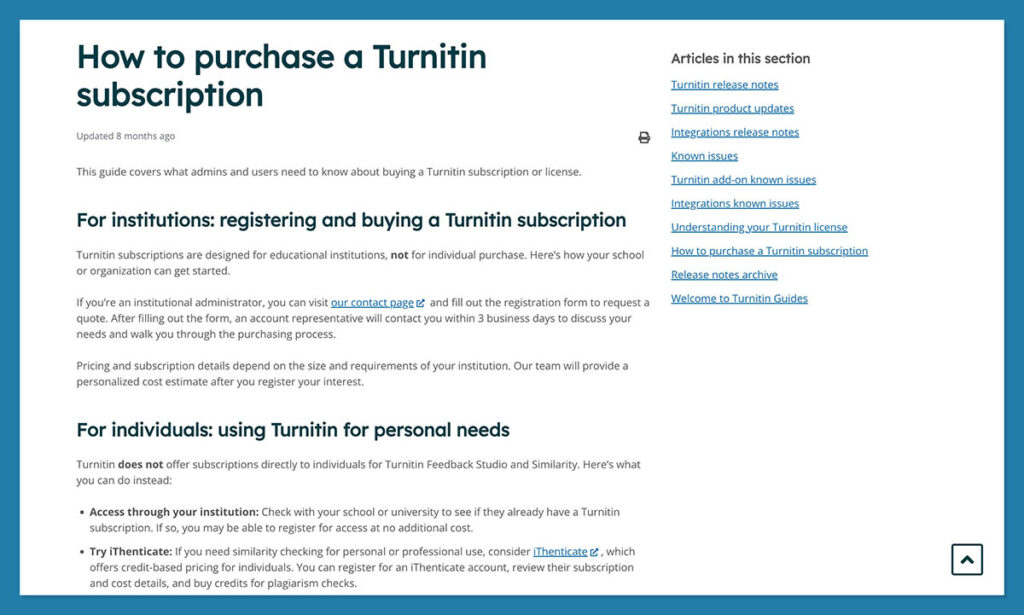
Turnitin has no public price list. What your institution pays depends on how many students you enroll, how long you’re willing to commit, and, candidly, how recognizable your name is.
Investigative reporting by The Markup pulled contract data from California public institutions and exposed the pricing reality. For basic plagiarism detection alone, the Cal State system paid $2.59 to $2.71 per student per year.
The AI detection add-on cost an additional $0.41 to $0.48 per student per year. Combined, Cal State locked in roughly $3.12 per student per year after negotiating a 13% discount on a seven-year contract totaling over $6 million. UC Berkeley secured a 10-year contract for $1.2 million.
Small community colleges without brand recognition or negotiating leverage? They paid up to $3.57 per student or more. Meanwhile, CUNY negotiated rates as low as $1.79 per student. As a former Cal State chief infrastructure officer put it, large universities get preferential treatment because Turnitin wants their logo on the client list.
What you do not get at any price tier:
- Individual student subscriptions (not available)
- A free trial
- Live chat support
- Phone support (email only)
| Institution Type | Per-Student Annual Cost | Contract Terms |
|---|---|---|
| Large university system (Cal State) | $2.59-$3.12 | 7-year contract, negotiated discount |
| Flagship campus (UC Berkeley) | ~$2.40 (estimated) | 10-year, $1.2M total |
| Large city system (CUNY) | $1.79 | Multi-year, high volume |
| Small community college | $3.57+ | Limited leverage, shorter terms |
The pricing disparity is the most consistent criticism across every turnitin review I’ve read. Small institutions subsidize the discounts that Turnitin extends to marquee clients. If you’re negotiating a contract, request itemized pricing for plagiarism and AI detection separately. Push for multi-year terms to reduce per-student costs. Small institutions should explore consortium purchasing to increase their leverage.
7. Data Privacy: Where Student Papers Go
When a student submits a paper through Turnitin, it enters a database of 1.8 billion documents. Every compliance officer should ask what happens next before signing a contract.
Turnitin operates as a “School Official” under FERPA and as a “data processor” under GDPR. Student submissions are stored in the database and used to check future work for similarity matches. Students can submit under pseudonyms if their institution configures it that way.
Data processing happens across multiple locations globally. Turnitin may process personal data in the United States, the United Kingdom, the EU (Netherlands, Germany, Poland, Sweden), Ukraine, the Philippines, Australia, or India. For institutions operating under strict EU data regulations, Turnitin offers the option to store submissions exclusively in Germany upon request.
The 2026 roadmap includes meaningful privacy upgrades. Granular retention policies will allow institutions to set exactly how long AI analysis artifacts are stored. Clear student-facing notices about what gets stored and why are coming. Institutions will also gain options to disable or limit storage for sensitive assignments entirely.
One note worth flagging: Common Sense Media paused its edtech review program in January 2026, so its Turnitin privacy rating is no longer being updated. If you were relying on that rating as part of your procurement evaluation, you’ll need an alternative assessment source. Conduct your own data protection impact assessment or hire a third-party auditor before signing.
For any turnitin review focused on compliance, the bottom line is this: FERPA and GDPR compliant on paper, with upcoming granular controls. Request the Germany-only storage option if you’re in a strict regulatory environment, and clarify retention timelines in your contract before signing.
8. New in 2025-2026: AI Bypasser Detection and Beyond
In August 2025, Turnitin started detecting text that students ran through AI humanizer tools like Quillbot and Undetectable.ai. The cat-and-mouse game between detection and evasion escalated significantly.
That was part of a broader August 2025 algorithm update. Detection rates for GPT-like content improved from 75% to over 92%. False positive rates dropped by nearly 40%. These represent a substantial upgrade to the core detection engine.
The full picture of what changed in 2025 and early 2026:
- AI bypasser detection (August 2025): Flags text processed through humanizer and paraphrasing tools
- Algorithm accuracy update (August 2025): 75% to 92%+ for GPT-like content, ~40% fewer false positives
- Turnitin Clarity (2025): Process-based writing transparency, TIME Best Invention
- Harvard and Chicago citation styles added to citation checking
- Footnote support (January 2026)
- AI chat in 19 additional languages within Clarity
- Enhanced Feedback Studio: Ranged rubrics, decimal grading, flexible grading scales, faster QuickMark creation
- 2026 roadmap: Granular data retention policies, multimodal detection for images and diagrams, signal decomposition
Approximately 10% of papers submitted through Turnitin contain 20% or more AI-generated content. That statistic drives the urgency behind these updates.
| Capability | 2024 Turnitin | 2026 Turnitin |
|---|---|---|
| AI detection accuracy | ~75% for GPT-like content | 92%+ for GPT-like content |
| False positive rate | Higher, widely criticized | Reduced ~40% |
| Bypasser detection | None | Active since August 2025 |
| Writing process visibility | None | Clarity (full timeline) |
| Citation styles | APA, MLA | APA, MLA, Harvard, Chicago + footnotes |
| Institutional governance | Limited | Granular retention policies (2026) |
The trajectory is clear. Turnitin is evolving from a single-purpose checker into a platform that covers detection, transparency, and institutional governance.
9. Turnitin vs. GPTZero vs. Copyleaks: How It Compares
Choosing the right tool requires looking beyond marketing claims. This turnitin review compares it against the two fastest-growing alternatives on the metrics that matter most for institutional procurement decisions.
Overall accuracy:
- Turnitin: 98% claimed, approximately 85% real-world (per CPO admission)
- GPTZero: 99.3% in a 2026 benchmark of 3,000 samples
- Copyleaks: 99.6 out of 100 mean score in a January 2026 study
False positive rates:
- Turnitin: Under 1% claimed for native speakers, 6-25% for ESL students (independent studies)
- GPTZero: 0.24% average, but 38% for non-native speakers
- Copyleaks: 0.03% overall, 13% for ESL students
Paraphrased and edited AI content:
- Turnitin: 40-70% for paraphrased, 20-63% for heavily edited
- GPTZero: 70% for edited content
- Copyleaks: 85% for edited content
Multilingual support:
- Turnitin: 30+ languages for similarity checking, English-only for grammar and citation checks
- GPTZero: 20+ languages
- Copyleaks: 100+ languages, with 95-96% accuracy in Swedish, French, and German
LMS integration depth:
- Turnitin: Canvas, Blackboard, Moodle, D2L Brightspace, Microsoft Teams, Schoology (deepest integration)
- GPTZero: Canvas and Moodle
- Copyleaks: Growing but less established in institutional LMS environments
Unique differentiator:
- Turnitin: Plagiarism database (1.8B papers), Clarity transparency tool, iThenticate for publishers
- GPTZero: 99.85% accuracy specifically on academic papers
- Copyleaks: Broadest multilingual coverage, lowest overall false positive rate
The ESL false positive problem affects all three tools, not just Turnitin. GPTZero’s 38% rate for non-native speakers is actually worse than Turnitin’s independent estimates. Copyleaks performs best in this area but still shows a 13% rate for ESL students.
One tool not included in this comparison is Originality.ai, which scored higher than all three in a meta-analysis of 13 studies and achieved 100% accuracy on Spanish-language AI texts. It targets content publishers more than academic institutions, but it’s worth monitoring.
For AI detection accuracy alone, Copyleaks and GPTZero outperform Turnitin in head-to-head benchmarks. For the full institutional package (plagiarism detection, AI detection, LMS integration, grading tools, and process transparency), Turnitin remains the only all-in-one option on the market.
The Bottom Line
Turnitin is not one tool. It’s a platform with a dominant plagiarism database, improving AI detection, a groundbreaking transparency product in Clarity, and documented problems with false positives, pricing equity, and ESL bias. Whether it’s right for you depends entirely on what you need and who you are.
For administrators: Turnitin remains the institutional standard for good reason. No competitor matches the database depth, LMS integration, or product breadth. Negotiate pricing aggressively, demand itemized costs for plagiarism and AI detection separately, and build an AI use policy alongside deployment. Never allow detection scores to serve as sole evidence in misconduct proceedings.
For educators: Use similarity reports confidently. Treat AI detection scores as a signal, not a verdict. Pair Turnitin with Clarity’s process transparency for high-stakes assignments. Require students to maintain writing portfolios with drafts and outlines. Consider disabling AI detection for short-form assignments or courses with large ESL populations.
For students: You cannot buy Turnitin individually. Protect yourself by writing in environments that track your process (Google Docs with revision history enabled, for example). Save outlines, brainstorming notes, and multiple drafts. Understand your institution’s academic integrity appeals process before you ever need it.
If your institution is evaluating Turnitin, request a pilot with AI detection enabled on a limited set of courses first. Collect false positive data from your own student population before rolling out campus-wide. The tool works. It just doesn’t work the same for everyone.
FAQ
Can individual students buy Turnitin?
No. Turnitin is exclusively institutional. Students access it only through a school that holds a Turnitin license. If you want to self-check your work before submitting, free AI detectors like GPTZero offer individual plans. These won’t produce identical results to Turnitin, but they can give you a rough estimate of your risk.
How much does Turnitin cost per student?
There is no public pricing. Based on California public contract data, basic plagiarism detection runs $2.59 to $3.57 per student per year depending on institution size and negotiating leverage. The AI detection add-on costs approximately $0.41 to $0.48 per student per year on top of that. Large university systems negotiate significantly lower rates than small community colleges.
What does the asterisk (*%) mean in a Turnitin AI report?
The asterisk appears when the AI detection score falls between 1% and 19%. Turnitin hides the exact number in this range because the detection model is not reliable enough at low thresholds to display a specific percentage. It means some AI patterns were detected, but at a level too low to quantify with confidence.
Can Turnitin detect paraphrased AI content?
Partially. Detection accuracy drops to 40-70% for paraphrased AI text and 20-63% for heavily edited AI content. The AI bypasser detection feature added in August 2025 helps catch text processed through humanizer tools, but sophisticated editing can still evade the system. This remains Turnitin’s most significant weakness.
Can a Turnitin AI score be used as proof of cheating?
Turnitin itself says no. Their documentation states the tool should not be used as the sole basis for adverse actions against a student. Multiple universities, including the University of Pittsburgh and Johns Hopkins, now formally require corroborating evidence such as drafts, outlines, and revision histories before taking any disciplinary action based on AI detection flags.
Does Turnitin store student papers permanently?
Student submissions enter the database and are used to check future work for similarity matches. Turnitin is FERPA and GDPR compliant. Students can submit under pseudonyms. EU institutions can request Germany-only data storage. The 2026 roadmap introduces granular retention controls at the institution level, giving schools more say over how long submissions are stored.